

Family farmers, local food systems, and climate resilience efforts are facing a lot of uncertainty in this year’s state budget. Big federal cuts to local procurement programs, reductions to SNAP, and worsening climate disasters are putting real strain on the systems that small and mid-sized farmers depend on.
These challenges and the solutions needed to address them are outlined in CAFF’s 2026 Farmer Policy Platform, our roadmap for strengthening California’s family farms and local food economies in the year ahead.
CAFF is advocating in Sacramento for state investments to keep family farmers on the land, support local food systems, and move climate resilience work forward.
We are fighting for nearly $100 million in funding to keep farmers afloat. This is broken down into:
- $45 million for local food purchasing by food banks from small and mid-sized farmers
- $15 million for climate disaster & emergency relief for small & underserved farmers
- $15 million to establish the first-ever land access program in California
- $14.8 million to establish a new equipment sharing & farmer cooperative program
- $9 million to continue investments in community food hubs
Fighting to Keep Farms Together Going
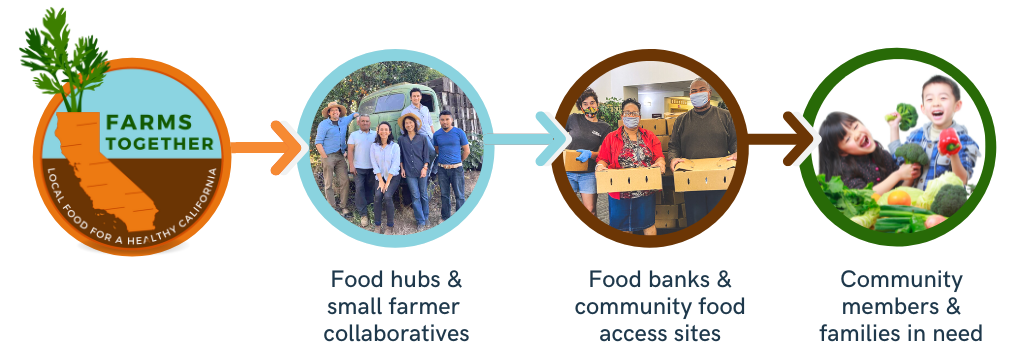
Due to over $100 million in federal funding cuts to values-based procurement programs, many farmers are already beginning to lose their most stable markets, institutions (e.g. schools and food banks). At the same time, discontinued funding will disrupt partnerships between farmers, food banks, and community-based distributors that keep local food flowing to families in need.
At the top of our priorities is $45 million to sustain the Local Food Purchase Assistance Program (LFPA), known in California as Farms Together.
Since 2023, Farms Together has delivered a powerful triple benefit:
- Economic stability for farmers
- Nutritious food for families
- Millions in local procurement
The program has demonstrated profound impact with over $44 million invested to engage:
- More than 800 farmers (70% of which are small, mid-scale, and socially disadvantaged)
- 43 food hubs and small local aggregators
- 34 food banks
This year, we are already seeing the infrastructure that connects local farmers to food banks, schools, and communities unraveling without state investment. As food security and farmer livelihoods continue to be strained, maintaining this infrastructure is critical for California’s agricultural resilience, economic health, and local food systems.
Maintaining the Climate Disaster Safety Net

Amid escalating climate disasters, continued investment in the proven California Underserved and Small Producer (CUSP) Program is essential to ensure California’s most vulnerable small and underserved farmers have a reliable safety net. CUSP provides direct emergency relief to farmers impacted by climate disaster ranging from drought, flood, to extreme pests. We are fighting for $15 million in state funding to keep this program going.
This program has already shown remarkable effectiveness, delivering over $24.5 million in direct relief to thousands of farmers, with 72-76% of funds having reached our state’s most vulnerable. This allocation aligns with the state’s climate resilience goals and provides the stability needed for rapid crisis response.
Investing Proposition 4 Climate Bond Funds in Farmers
Proposition 4 presents a major opportunity to make structural investments that address long-standing barriers for small-scale producers. Prop 4, or The Safe Drinking Water, Wildfire Prevention, and Protecting Communities and Natural Lands from Climate Risks Bond provides huge investments in initiatives to promote healthy soils, fair groundwater access, affordable land access, equipment sharing, farmer cooperative TA, urban agriculture, and farmers market infrastructure, to name just a few.
CAFF is advocating for the following funds from Prop 4 to be included in the FY 2026–27 budget and begin implementing programs:
1. Land access for socially disadvantaged & beginning farmers and ranchers – $15 million
Socially disadvantaged and beginning farmers in California face deep challenges in accessing and securing affordable farmland. Right now, there’s no dedicated state program that provides the financial or technical support farmers need to secure long-term land access.
Prop 4 set aside $30 million to start tackling this issue, but we still need clear language in statute to make sure the program is set up to work. That’s why we support including implementation language in the budget, negotiated with the Administration and based on AB 524 (Wilson, 2025), to give the Department of Conservation clear direction.
2. Equipment Sharing & Farmer Cooperative Program – $14.8 million
Small farmers often cannot afford the essential equipment needed for sustainable practices, processing, and business viability. A program focused on equipment sharing and farmer cooperatives is foundational to long-term farm sustainability and resilience. After years of advocating for the creation of this program with legislation that resulted in two vetoes by the Governor (AB 552 Bennett in 2023 and AB 2313 Bennett in 2024) we fought and succeeded in including this program into the climate bond. The Governor’s proposal includes $14.8 million of Prop 4 funds to establish this program at CDFA, and we are going to make sure it ends up in the final budget this year.
3. Farm to Community Food Hub Program – $9 million
This program, established by AB 1009 (Bloom, 2021), strengthens regional supply chain infrastructure so small-scale farmers can aggregate and access institutional markets.
Demand for the program demonstrates its importance:
- The first round of funding was oversubscribed by nearly 1,000%
- Applicants requested over $147 million, but only $13.5 million was available
We request $9 million from the suitable Prop 4 funds be allocated to the Farm to Community Food Hub Program for the FY 2026-27 budget. The Legislature has previously demonstrated its commitment by securing funding for this program across two budget cycles, and it is critical that we continue recognizing its foundational role in strengthening local and regional food supply chains.
In Summary: A Critical Moment for California Agriculture
These investments total $98.8 million in one-time funding — a strategic commitment that would:
- Stabilize small and socially disadvantaged farmers
- Protect local food systems from federal funding volatility
- Improve food access for communities
- Build long-term climate resilience
- Strengthen relationships in regional economies
State leadership is more important than ever. CAFF looks forward to working with the Legislature and the Administration to ensure these critical investments are included in the FY 2026–27 budget.
See here for CAFF’s recently released 2026 Farmer Policy Platform.