
Increasing biodiversity can often lead to success in battling pests on small farms. Through the creation of diverse habitat, growers can attract natural predators to their property which can help keep pest pressure at bay. On June 3rd, CAFF’s Ecological Pest Management team co-hosted a field day at Il Fiorello Olive Oil Co in Fairfield, CA. In collaboration with staff from the UCCE Wildlife Program, attendees were able to explore a tiered strategy to integrated pest management, or IPM. CAFF’s Ecological Pest Management team takes a holistic approach to managing pests that includes a suite of practices which farms and ranches can employ based on their own unique needs and circumstances. There is never a one size fits all approach to battling pests. As growers build biodiversity and increase biological control methods, they can reduce reliance on harsher pesticides. As we learned at Il Fiorello, this can look many different ways.

Over 20 growers from across California gathered at Ann Sievers’s property and discussed the benefits of various bird species and learned about trapping methods for gophers. Great resources were shared and we all learned a lot. The day started off with Ann sharing a bit about the farm, which has 3,000 olive trees on 17 acres. She has really focused on diversifying her operation and ecosystem to include citrus and apple trees, and annual vegetable crops, which you can enjoy if you have lunch at their on-site bistro. Additionally, Il Fiorello operates its own olive mill, producing high quality oil for themselves and others who bring their olives to them.
“Two times a year in the fall harvest season, we do community milling. This is an event that we have done for almost 15 years now. For example, if you’ve got two olive trees and you don’t know what to do [with the olives], you bring your crop to me, [and we mill it for you]. The last community milling in November 2023, we had 91 families bring 17,000 pounds of olives to us.” Ann Sievers
Breanna Martinico (@UCWildAg), Human Wildlife Interactions Advisor for Napa, Lake, and Solano Counties, along with Tom Clark of Aloft Napa Valley consulting, explained what types of birds are beneficial to have on farms – because they eat either insect or rodent pests – and the sizes and designs of nest boxes growers can use to encourage them to stick around. They demonstrated the different types of nest boxes needed to encourage barn owls, American kestrels and beneficial songbirds, such as western bluebirds and tree swallows, to nest on your farm.
“We’re really lucky here in California to have such a diverse array of beneficial species that can contribute to our pest management efforts. That being said, it’s not a silver bullet. It’s one strategy. It’s an ecological strategy that we can use to promote beneficial species to help us.” Breanna Martinico
Each species needs to feel safe in their nest, so ensuring the boxes are not accessible to predators is a great key to success. This can be done by considering where they are placed – for example, mounted on a metal pole which is harder for predators to climb than a tree. You will also need to consider the shape and size of the box, making sure they are deep and wide enough for baby birds to stay out of predators’ reach. Another thing to consider is the direction you orient the nest box opening. Making sure the opening is not exposed to prevailing winds and incoming storms will make the boxes much more enticing.
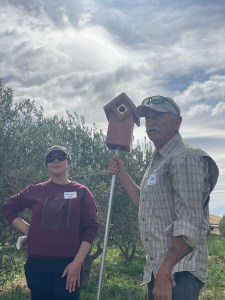
Breanna noted that Barn owls can consume upwards of 3,000 rodents per year for each nest, so you can imagine how placing just one box on your farm can reduce the amount of rodent pest pressure on your crops. She also mentioned that this isn’t a “set it and forget it” approach. Owls can get too crammed in nest boxes that are full of debris, so it’s important to check the boxes each year in late summer/early fall and clear out owl pellets, feathers, etc., from the previous year, leaving a small layer of their debris or wood shavings. For this reason, it is good to design a box with an opening on the side so you can easily clean it out. Also of note is that the young owls stay in the nest for around two months and can be quite loud at night when they are feeding, so you will want to place the nest box at a good distance from any dwellings.
“Typically we have the most success for songbird, owl and kestrel nest boxes the following year if you get them up in fall. And that’s because [the birds] need time to look for [the boxes], find them, and hold territory over them in time before the breeding season actually gets underway.” Breanna Martinico
American kestrels are a declining species and are harder to attract than owls and songbirds, so providing habitat for them is a great way to encourage their presence in your ecosystem. They prefer grassland and other mostly open habitats with some trees for perching. Nest boxes for the kestrels are quite a bit smaller than owl boxes and only need a 3” diameter hole for entry, which prevents larger avian predators from entering the boxes. Since kestrels don’t build their nests, they also appreciate having a bit of wood shavings in the bottom of the box to form their nest in. For owl and kestrel boxes, you will want to place them about 100 yards apart if you have the ability to put more than one on your property. This will give each nest the space to feel safe and secure.
Songbirds, such as Western bluebirds and tree swallows, can be housed in much smaller boxes placed only 15-30 yards apart. These swift, agile flyers eat insects all day long, either by perching on plants or as they are flying around, which is a great way to control pests such as grasshoppers, beetles, and ants without the use of harmful pesticides. Songbird nest boxes are much smaller with only a 1.5” opening, and you need to mostly be aware of placing them in areas free from domestic cat predation. These birds bring in grasses and other materials to build their nest, and they also appreciate a clean box every fall, so you will need to clean them out every year. This can be done in fall or later in winter.
Dr. Roger Baldwin, Cooperative Extension Specialist: Human-Wildlife Conflict Resolution, also joined us to demonstrate trapping techniques for the pocket gopher, a common problem for many growers in California. This is where the “tiered approach” to pest management enters the picture. You can place owl and kestrel boxes on your property, while also implementing a trapping plan to have the most success. Roger shared that, if done well, trapping can eliminate more than 90% of the gopher pressure on a farm. He explained how you can determine if you have moles, pocket gophers, voles, or all three on your property. The burrow system and mounds left by each rodent are distinctly different. For the purposes of learning one very handy skill, Roger focused on the pocket gopher and the use of physical traps. He demonstrated how to locate and prepare the tunnel system for traps.
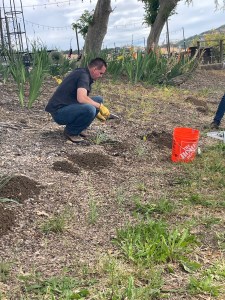
Dr. Baldwin showed the growers several types of traps, most of them classified as snap or cinch traps which are often spring or tension loaded and essentially catch the gopher which dies within a few minutes without the use of poisons or even baits. Once traps are set, it’s also important to secure it in some fashion.
“You need to stake it down for two reasons. Number one, the gopher won’t die instantly. It will hopefully die shortly after capture, but it will live long enough to pull that trap back down into the tunnel and you might lose it. Number two, everything loves a gopher. Foxes, coyotes, raccoons, skunks, you name it. If they smell a dead gopher, they’re gonna pull it out.” Dr. Roger Baldwin
During the demonstration, the crowd was able to see first hand what a fresh gopher mound looks like since a gopher was being very industrious close by. At densities of up to 70 gophers per acre, these little critters can sometimes have detrimental effects on a farmer’s bottom line, affecting both annual and perennial crops. Determining your IPM strategy early on is essential to a farmer’s success, and it was so great to hear about some relatively easy strategies to implement.

The day was rounded out with a guided tour of Il Fiorello’s olive orchard and gardens with Ann, followed by a lovely lunch made from their garden veggies and signature olive oil.
Photos and blog by Layla Aguilar, CAFF’s Ecological Farming Program Specialist layla@caff.org