
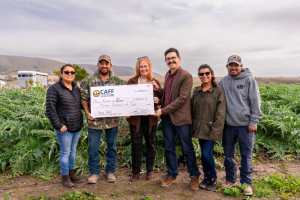
 After another year of providing drought relief grants to small farmers across California, Community Alliance with Family Farmers (CAFF) is launching a new financial relief program for farmers impacted by climate extremes, which will open for applications in spring of 2025. The California Family Farmer Emergency Fund provides direct financial relief for farmers who face increasingly unpredictable growing conditions due to drought, wildfires, floods, and other climate disasters.
While the fund was initially established in 2017 to assist wildfire survivors, CAFF has expanded its scope in subsequent years to support farmers impacted by the rippling consequences of the pandemic, as well as the statewide multi-year drought.
 When heavy rains hit the Central Coast region in winter 2022, the drought-ridden landscape was unprepared for so much water and devastating floods struck the region. Farmers lost entire fields of crops, expensive infrastructure, and even their homes. Rising to the occasion, CAFF raised and distributed $283,750 to small family farmers impacted by this crisis, thanks to community partners like the San Benito Community Foundation, the Silicon Valley Community Foundation, and the Community Foundation of Santa Cruz County.
However, farmers continued to struggle with the lasting financial impact to their businesses and livelihoods. District 28 Assemblymember Gail Pellerin saw farmers in her region struggling to rebuild after the crisis and secured a financial lifeline for these growers. “Farmers are the backbone of our society. Unfortunately, farmers are on the front line of the climate crisis and the state must step in to help our farmers when disaster strikes,” said Assemblymember Pellerin. “I was proud to be able to secure [disaster relief funding] in the 2023 budget, and with the help of the Community Alliance with Family Farmers that money is now getting out and into the hands of farmers who were affected by disaster.”
 Since 2017, CAFF’s emergency fund has provided grants to over 500 farmers, totalling approximately four million dollars in direct financial relief, with well over half of grant recipients identifying as farmers of color.
“While historically the Family Farmer Emergency Fund has responded to crises as they arise, CAFF is hoping that by providing more expansive funding in the form of a Climate Extremes program, farmers from diverse regions of the state will be able to turn to CAFF as a resource for financial resilience across varied, and often concurrent, climate extremes,” says Paul Towers, CAFF’s Executive Director.
CAFF runs the Family Farmer Emergency Fund program in English and Spanish and, as the program has grown, has hired additional staff who can provide direct support to farmers applying in both languages.
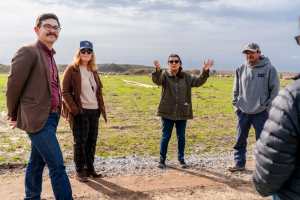 CAFF kicked off funding with an initial $15,000 grant to Rancho Las Palmas, one of the farms hardest hit by storms in Santa Cruz County. “We were not expecting this storm, and the damages that it made to our farm,” said farm co-owner Teresita Diaz. “We lost a little bit more than a quarter of our product that was ready to be harvested. We also lost about 20 sheep that died, due to the heavy storm, when their shelter was partially destroyed. The cover crop that we had planted, as well as compost that we had purchased, got washed away.” Rancho Las Palmas co-owner Maria Perez added, “Small farmers like us often don’t know where to go or can’t access resources when we most need them… CAFF was able to provide us with some important initial emergency financial assistance and we are pleased to see new resources that can help farmers like us.”
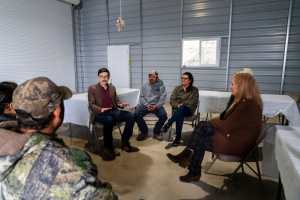 Applications for storm and flood relief will be open starting March 2025 and will cover financial losses from 2022, 2023, and 2024. Grants will range from $5,000 to $20,000 and will be selected by a diverse Grant Review Committee. Grants are reimbursement-based, meaning farmers can apply to receive payment for unexpected expenses or financial losses incurred due to storms, flooding, or other extreme weather events. CAFF will continue to distribute drought relief assistance in the fall of 2025, which has been provided by the California Department of Food & Agriculture’s California Underserved & Small Producer Program (CUSP).
More information about the fund is available here: www.caff.org/cafamilyfarmeremergencyfund
Photos by Christine La