
A Holistic Approach to Fuels Management and Soil Health
Written by Josh Harjes, 2023-2024 Grizzly Corps Fellow at CAFF’s Wildfire Resilience Program.

Biochar is a cost-effective soil amendment and also offers a plethora of other environmental benefits. In this blog post, I’ll share insights and lessons learned from a workshop I attended regarding the practice of pile burning for biochar production, and also introduce the benefits and limitations of biochar use.
Indigenous peoples in the Amazon first created biochar to increase the productivity of the soil, which is characteristically poor in nutrients. They did so by burning agricultural waste and then smothering it. Biochar is produced when biomass is heated to combustion temperatures, but then suddenly deprived of oxygen. This chemical process is called pyrolysis, and produces charcoal, or, biochar. Portuguese settlers called these Amazonian soils terra preito do indo which means Indian black earth. The repeated application of biochar over many years turned these nutrient-poor soils into fertile agricultural land.
Creating Biochar: Methods and Processes
Biochar can be produced using specialized biochar kilns or through traditional methods like pile burning. Modern biochar kilns utilize controlled pyrolysis to convert biomass into biochar efficiently. These kilns can be tailored to produce biochar with specific properties suited to different soil types and agricultural needs. Biochar can also be created without expensive pyrolysis kilns by pile burning. Pile burning is a very controlled fuels management practice that can be implemented during wetter, colder months when broadcast burning would be ineffective and produce too much smoke. In March, I got to participate in a two-day workshop with the Laguna de Santa Rosa Foundation teaching private landowners pile burning for ecological health.

The field day portion of Laguna de Santa Rosa Foundation’s Pile Burning Workshop was held at Shone Farm, Santa Rosa Junior College’s student farm in Sonoma County. Sonoma county encompasses many environments: wet and foggy coastal redwoods, agriculturally fertile valleys, interior coast range oak woodland, densely populated cities, rural communities, and thriving tribal groups. Catastrophic wildfires and smoky conditions have affected this county, particularly in 2015, 2017, and 2018. Forced to rebuild and reimagine life after these fires, as well as a community that is passionate about healthy ecosystems has made the North Bay Area in general, and Sonoma County in particular, a hub of burgeoning wildfire resilient communities.
Pile burning took place in the forested lands of Shone Farm, under canopies of douglas fir, california bay, and black oak. Burning under a forest is generally safer than in open grassland. Changes in wind can quickly cause dramatic changes in fire behavior. The trees break up local winds, reducing the danger of shifting winds causing unforeseen fire behavior. Additionally, some canopy cover keeps fine fuels wet for longer, granting reduced chances for pile burns to ignite nearby surface fuels.
Before heading out to the forest, Asa Voight, fire practitioner and land manager with the Foundation and co-leader of the workshop, made a call to the local air quality management district to register the burn. This was as simple as leaving a message with the burn location and relevant contact information. Even though most of the surrounding fuel types were somewhere between damp and soaked, conditions were perfect for pile burning. The previous weekend had seen heavy rain, soaking even the heavy fuels present in the forest. Then the area experienced sunny, warm temperatures in the couple days leading up to our burn day. This dried out the fine and medium fuels in the piles, making them easier to burn. When dry, leaf litter creates fuel continuity between the burn piles and can cause small amounts of pile creep to become larger fires. The high relative humidity of the morning meant that pile creep would likely not be a problem. With appropriate PPE (long-sleeved natural fibers, leather gloves, and leather boots) and optimal burning conditions, we were ready to begin.
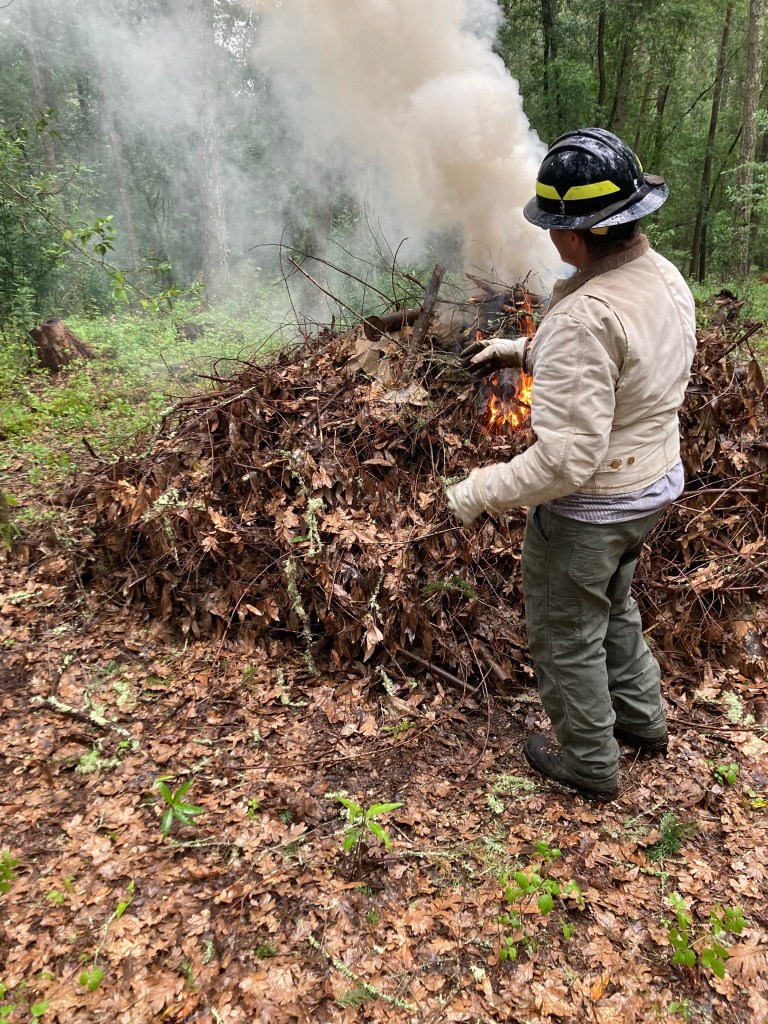
Bill Basquin, local fire practitioner of Sonoma County and co-leader of the workshop, lit the first pile with nothing but douglas fir twigs, some newspaper, and a lighter. After a few moments of stoking the small fire, smoke began to rise and the pile itself ignited. All piles were burned from the top down. This is called a conservation burn, which minimizes heating of the soil. The fire created significant smoke at first, which drifted north towards the nearby Russian River. After just five minutes or so, enough heat was being generated that the pile created far less smoke and drove the smoke higher up into the air. We then split up into four person teams and commenced ignition of the dozen or so piles that were to be burned that day. Bill and Asa had brought various tools and equipment to practice all kinds of ignition techniques. The drip torch, arguably the most recognizable tool of fire practitioners, didn’t actually perform very well in the conditions. The amount of fuel needed to get the damp wood to ignite was more than the drip torch could efficiently dispense. This was an interesting case where the drip torch was less effective than the comparatively “basic” method of ignition using twigs and a lighter. A drip torch is extremely effective at igniting fuels, but not at creating heat. The campfire method, while difficult to get going, produced more heat than the ignition from a drip torch would have. This was more effective because then the remaining fuels in the pile were being preheated and more ignition-ready. And anyways, it didn’t make a lot of sense to us to douse the piles in diesel and gas when not necessary.
The first pile had been burning for some time now and hot coals were available at the base, if you could get to them. We employed another pile ignition technique using just these coals and a shovel. We carried the coals over to another pile, poured them on top, and then coaxed the new pile to ignite by adding a little nest of fine fuels. This method did a great job of igniting the remaining piles.
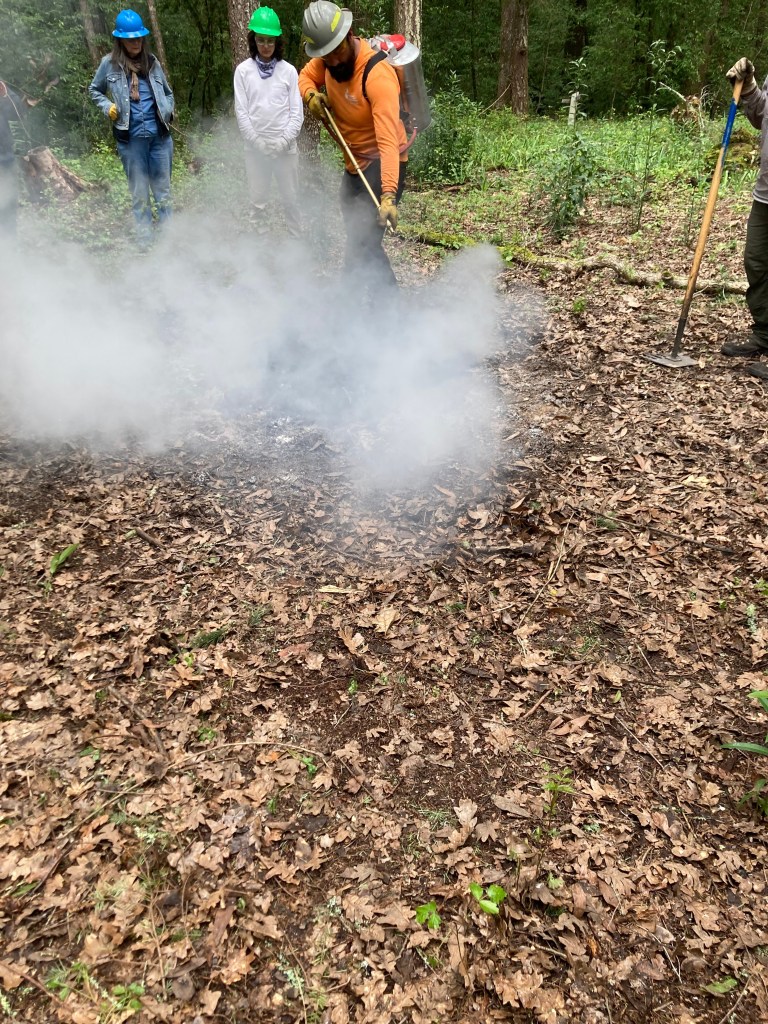
When the fire had consumed most of the wood in the burn piles, it was time for extinguishment. In order to protect the soil below a burn pile, it is important to extinguish the flames just before all the wood has burned to ash. Timed right, the soil microbes are not damaged and biochar is created. Using backpack water pumps, we extinguished each pile with generous sprays of water. After all the embers were extinguished and cooled, we raked the biochar back into the surrounding soil.


Biochar created from the burn piles. Personal Photo
Laguna de Santa Rosa’s Pile Burning Workshop allowed members of the community to get hands-on training doing ecologically beneficial land management in a low-stakes, learning environment. Many participants shared how participating in the workshop had greatly increased their confidence in doing pile burning on their own. In the wake of the devastating toll that wildfires have taken on this region, experiencing first-hand what ‘Good Fire’ looks like is a powerful healing process–for the land, and its inhabitants. Community-level workshops like this one are invaluable for fostering wildfire resilient communities.
Biochar Pros and Cons
Biochar is renowned for its multifaceted benefits, making it a valuable tool in agricultural and environmental stewardship:
- Long-term Carbon Sequestration: One of the most significant advantages of biochar is its ability to sequester carbon in the soil for hundreds of years. Available carbon is biomass that can readily be converted to carbon dioxide by processes like burning and soil microbial activity. Stable carbon refers to biomass that will not be entering the atmosphere anytime soon. By converting biomass into stable carbon structures through pyrolysis, biochar effectively arrests the release of carbon dioxide to the atmosphere.
- Pollutant Binding: Biochar acts like a sponge in soil due to the relatively high surface area which is useful for capturing very small particulates, making it great at trapping heavy metals, pesticides, and organic pollutants. This property of biochar helps remediate contaminated soils, making them safer for agriculture and reducing environmental contamination. Another holistic management practice that effectively binds and removes pollutants in the soil is called Fungal Bioremediation.
- Nutrient Retention: Biochar enhances soil fertility by reducing nutrient leaching. It retains essential nutrients like nitrogen and phosphorus in the root zone, making them more readily available to plants over an extended period. This characteristic not only improves soil quality but also reduces the need for fertilizers.
- Improved Water Retention: Due to its porous structure, biochar increases soil water holding capacity. This is particularly beneficial in arid and semi-arid regions, where water scarcity limits agricultural productivity. By holding moisture in the soil, biochar helps plants withstand drought conditions and pest pressures.
- Enhanced Crop Yields: In nutrient-poor soils, biochar application can increase crop yields. By improving soil structure and nutrient availability, biochar fosters healthier root growth and better overall plant health. See a summary of results from a biochar project at Oasis Vineyard Trail in Monterey County for more detailed information
While biochar offers numerous benefits, scaling up its production presents several challenges:
- Economic Viability: The logistical challenge of moving biochar kilns to remote, or hard to reach areas prevents cost-effective access to biochar kilns for farmers.
- Technological Optimization: Efficient biochar kilns and pyrolysis technologies must be developed to maximize production while minimizing energy consumption and emissions. See this research paper on the energy balances and economics of biochar production to learn more.
- Meager crop yield increases: A 2021 UC Davis study measured the increase in crop yield after biochar additions and found that in fertile soils like those found in California, biochar addition did not increase crop yield significantly.
Embracing Holistic Land Management
Biochar exemplifies the potential of integrating sustainable agricultural practices with climate change mitigation efforts. Seeing first hand at the workshop how a simple practice like pile burning can achieve multiple ecological benefits inspired me to always look for multi-benefit land management strategies. Multi-benefit and holistic land management strategies like biochar production from fuels management projects can sequester carbon, improve soil health, and enhance crop productivity all at the same time. Adopting simple and affordable holistic management practices will cultivate resilient agricultural systems that benefit both people and the planet.
To read more about the benefits of biochar, check out these testimonials from Napa Green, a climate resiliency and regenerative agriculture non-profit organization in Napa County!
To learn more about the Community Alliance with Family Farmers’ Wildfire Resilience Program, visit our program homepage!
References and Links
AirBurners Burnboss biochar kiln
American Farmland Trust: The Dirt about Biochar – And How It Could Help California
CAFF Blog Post: Mushrooms For Wildfire Resilience
CAFF Blog Post: Pile Burning on Working Lands: Siskiyou County
CAFF Wildfire Resilience Program
CharGrow: How Biochar Affects Nutrient and Water Retention
Climate Foundation: Land Carbon Sequestration: Biochar
Laguna de Santa Rosa Foundation
Missoula Fire Seminar Series: The Economics of Using Forest Biomass from Fuel Reduction for Biochar
Napa Green: The Benefits of Biochar
Oasis Vineyard Trail Biochar Project
Significance of Biochar Application to the Environment and Economy
Sonoma Biochar Initiative: Step-by-Step How to Do a Conservation Burn