
Steeped in the culture and cultivation of beekeeping, Glenn county (where Orland and Capay lie) is part of the famed “Golden Triangle” of bee production (Butte, Glenn, Shasta, and Tehama counties). Tens of thousands of queen bees are reared here annually, leading Orland to be nicknamed the “Queen Bee Capital of North America’- roughly 80% of U.S. commercial queen bees originate in Northern California (pointsoflight.org). Moreover, beekeepers in the Orland area (such as Can-Am Apiaries, Heitkam’s Honey Bees, C.F. Koehnen & Sons, and Olivarez Honey bees) collectively are also active in: pollination contracts, and honey production, as mentioned by long time beekeeper Pat Heitkam. Pollination provided by bees in the Orland area is integral to the almond industry and other pollinated crops across the state.
Beekeeping Realities: Crisis and Opportunity
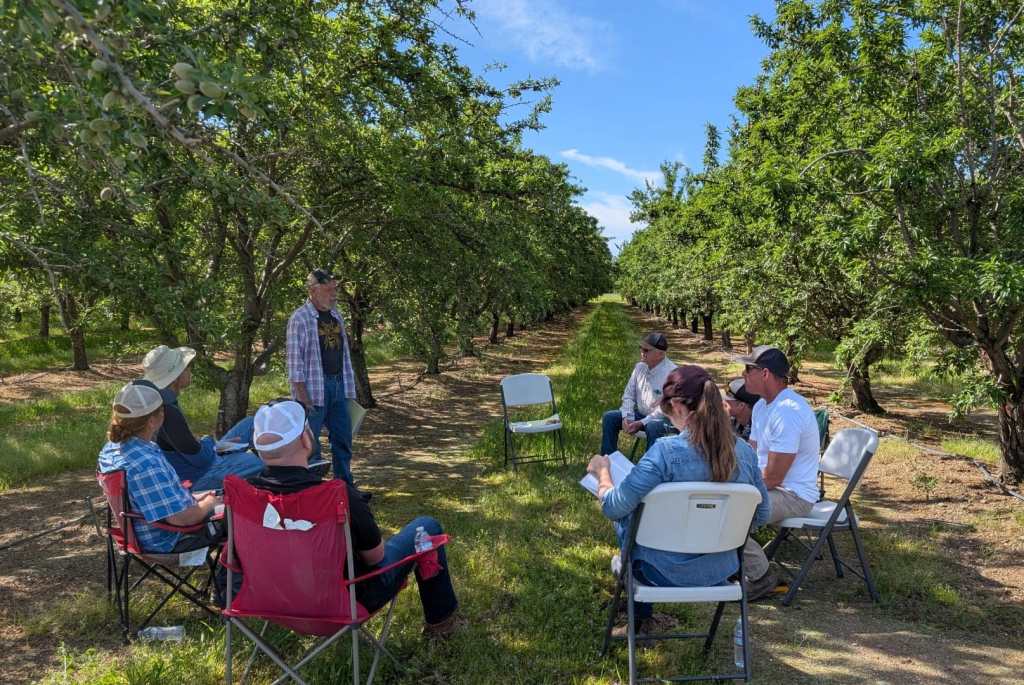
Pat Heitkam, a seasoned beekeeper of Heitkam’s Honey Bees and former President of the American Beekeeping Association, shared hard truths about the state of the industry. National bee colony losses have spiked—62% this year alone. Stressors like pesticide exposure, tracheal mites, habitat loss (especially loss of dairy pastures) and inundation of conventional orchards have taken their toll on the landscapes that were once more supportive homes for honey bees, wild and commercial, and native bees. Heitkam emphasized that moveable hives are often packed with up to 20,000 colonies in a single yard—a condition ripe for disease and stress for the bees. Anecdotally, he mentioned a bee keeper who operates a substantial bee keeping business in three states (California, Montana, & South Dakota) and who lost 80% of his colonies in South Dakota and 50% in the two other states recently.
A contributing factor to losses seen large scale is varroa mites and the diseases transmitted by them. Currently, 85% of varroa mites have developed resistance to common pesticide treatment options like Amitraz. Many beekeepers are increasing dosage and frequency to help curtail the mites, but once they take foothold, it’s usually too late. Adding fuel to the fire, recent funding cuts has left vital university-led research stalled. Despite the grim situation, Heitkam remains committed to “playing the long game”, focusing on sustainable management practices, advocating for better collaboration between growers and beekeepers, and improved understanding of lesser-known stressors like growth regulators to help bridge knowledge gaps moving forward.
He also highlighted innovative farmer-beekeeper led organization, Project Apis m.. Looking to finance an endeavor for the business, already having landed their honey at Costco, a negotiation between both parties had Project Apis m. receiving so many cents per lb of honey sold through Costco. Furthermore, Costco agreed to have Project Apis m. manage these funds as they saw fit- this figure amounted to $400,000 a year. This birthed the Seeds for Bees program. Programs like Seeds for Bees offer financial incentives in the form of cover crop seed mixes with pollinator-friendly plants to growers—$2,500 worth of seed in year one, $1,500 thereafter. These habitats, provide multiple benefits. For instance,these cover crops increase pollinators, but they also help to mitigate soil runoff. One “low-hanging fruit” is to plant these cover crops in young, not yet producing, orchards.
Another challenge Pat identifies is restricting managed honeybees from being able to be left to forage on federal land. Federal land is often important habitat that can boost bee colony health. An attendee who collaboratively works with conservation agencies on land previously used for agricultural production proposed having both parties (beekeepers and conservationist) network to entertain the possibility of creating promising solutions aligned with both interests. This conversation, highlighted the theme of trying to find sustainable opportunities in crisis.
Agricultural Reflections: Doug Boone on the Changing Landscape
“A challenge is nothing more than a form of opportunity”, Doug Boone, owner of Boone Ranch, recapitulated Pat Heitkam’s talk succinctly. As well as farming, back in 1978, Doug Boone, became one of California’s first licensed Pest Control Advisors (PCAs). He focused on weed and pest control in California. Capay has been long known to the Boone Family. They are one of the three generational families that have lived there since the Land Grant Act.
Starting out with conventional practices and using ample pesticides, Doug has since shifted his approach. He described returning home to agriculture in 2014 from working in other places as a “Rip Van Winkle” moment; he was shocked by the diminished presence of beneficial insects. “If we continue to use pesticides the same way,” he warned, “we’re going to do a lot of damage in this world.”
Boone underscored the importance of managing native pollinators and creating resilient ecosystems, from reducing air blast spraying to investing in cover crops and non-productive land for pollinator habitat. Doug has grown in this journey with Pat. Doug and Pat have known each other for a greater part of their lives back when they both used to work together on the very same land where we hosted the field day, which was previously a dairy farm and now is a almond orchard.
Ground Squirrels: Winning the Battles, Losing the War?
Doug Boone offered a deep dive into one of agriculture’s persistent nuisances: the California ground squirrel. With rising populations due to warmer winters, these rodents are expanding their range and are increasingly problematic. Their presence in agricultural production has the potential to create diminishing returns for growers as they decimate irrigation systems, consume harvestable products causing loss of produce , and can even kill almond trees, especially young trees.
Understanding their characteristics is key to best method of control. For one, they have an elaborate tunnel and chamber network. Their tunnels can range anywhere from five to as much as about 25 feet in length. They have “purpose-specific” chambers (i.e. hibernation, nesting, food storage, etc) that extend down 6-7 feet deep with multiple entry points.This makes it difficult to seal off or infiltrate their network.
He laid out a thorough, step-by-step approach to control—beginning with surveying the area for colony activity. Weed management is huge. Grasses provides them with their preferred native diet; thus, clearing out weeds near their burrow opening discourages them.
Sealing their burrows helps to hone in on an area of focus in order to help target bait appropriately. Covering and flagging all openings will forcibly make the ground squirrels re-establish their exit/entry points allowing you to observe more about their activity and potentially reducing their access points.Some openings will be reopened and some will stay closed. The restriction of active access points to and from ground surface will set you (the pest manager) up to be selective with choice of bait and pesticide products.
Very enthusiastic with his line of work as a PCA, Doug was quite eager to show attendees a line up of his tool arsenal. From the looks of his weathered accoutrements, it was apparent that many methods remained in his “tool belt” because they are tried and true.
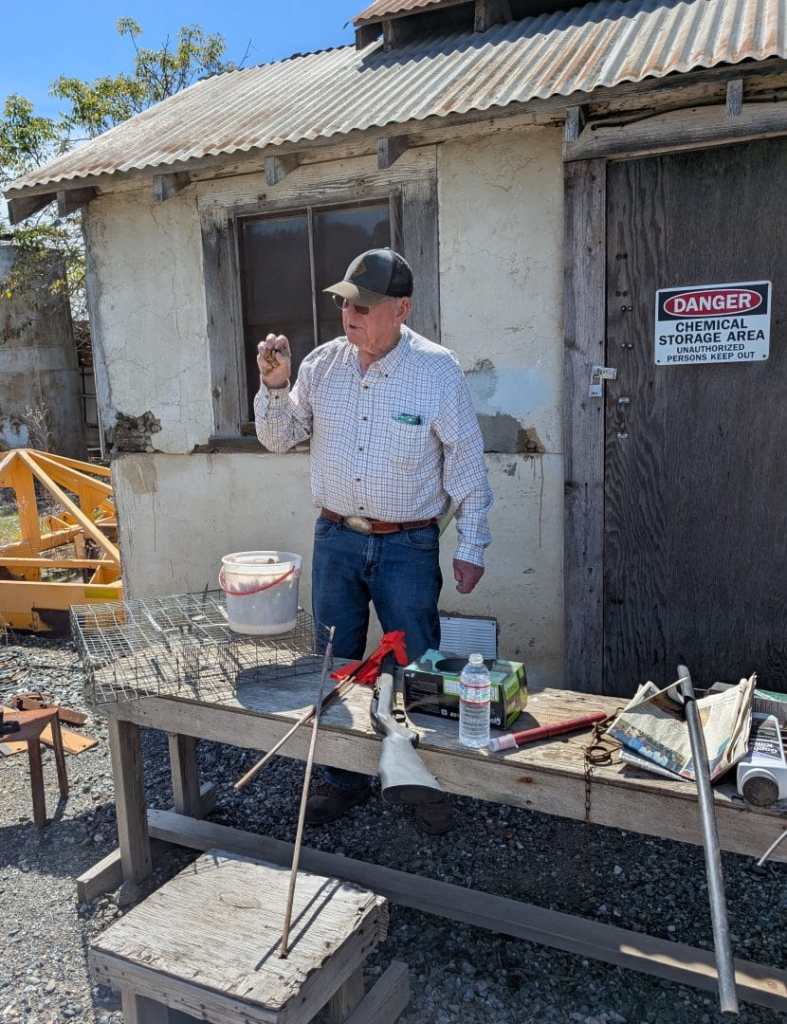
Overall, Doug’s insights were pragmatic and experience-based indicative of a seasoned veteran who has honed his craft through trial and error. Such examples include using almonds initially in the bait station, conditioning them to trust food, and then, ultimately, transitioning to almonds with vitamin K inhibitors. Doug also emphasized timing of using bait stations using them in the fall and early winter when food sources are scarce. He notes that an unintended drawback from removing flood irrigation for irrigation efficiency was elimination of a helpful cultural practice.
Still, he was candid: “With ground squirrels, you can win every battle and still lose the war.” Ground squirrels have a high fecundity and can re-inhabit existing burrows, giving them a high population growth and strong ability to recolonize. Persistence is required to mitigate populations
Closing Thoughts: From Challenge to Opportunity
Throughout the day, a central theme echoed: if approached with intention and care, today’s problems are tomorrow’s opportunities. Whether it’s integrating bee-friendly practices, adjusting pest management, or responding to shifting environmental pressures, the future of agriculture lies in adaptability and collaboration.
As Doug Boone put it, “Ag as a whole across the nation is holding its breath.” But with community-led conversations like this one, there’s reason to believe we’ll exhale with hope.