
On April 10th, Community Alliance with Family Farmers (CAFF) hosted a field day at Heartwood Farms in Linden, CA with farmers Franz Eilers and Emma Wade to discuss all things compost and pest management on their biologically-integrated walnut and cherry orchards. The pleasant weather attracted a sizable crowd of growers, researchers, and technical assistance providers who shared interest in learning about nutrient management in holistic farming systems.
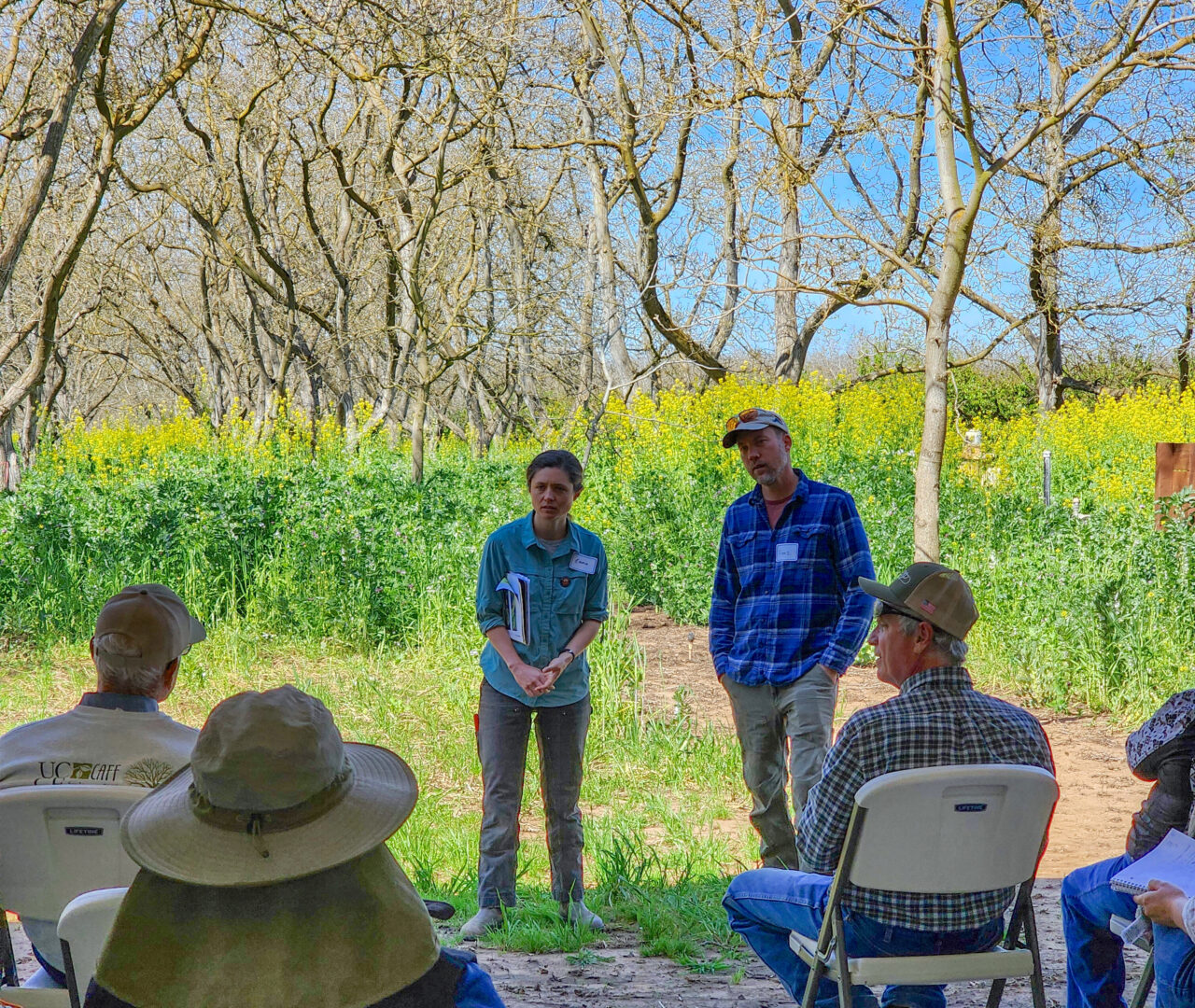
The event, coordinated by Emma Centeno, took place against a whimsical backdrop of towering walnut trees – aged almost 45 years – interspersed with lush stands of blooming cover crop that rivaled people in height. Discussions kicked off with Hanna Kahl, CAFF’s Ecological Pest Management (EPM) specialist, providing background on the organization’s pest management research from the ‘90s, known as BIOS. Hanna explained how some components of those projects are being revived through CAFF’s current research experiments which study the effects of natural spider mite enemies on walnut and winegrape pest populations.
Heartwood Farms enthusiastically serves as a partner for this research, which investigates the effects of predatory mite releases via drone, predator food sprays, and natural enemy enhancing compounds. The EPM team monitors the pest and beneficial insect populations over the field season with leaf sampling and sticky traps placed in tree canopies. Preliminary data shows that Heartwood Farms boasts an astonishing array of beneficial insects. On average, 21% of leaves hosted an arthropod natural enemy of spider mites. Most frequently observed on sticky cards were predatory mites, but other beneficials found in large numbers were the sixspotted thrip, green lacewing, and spider mite destroyer. Spider mite destroyers in particular are not frequently observed in walnuts sampled in the region. Abundant natural predator populations suggest that there is sufficient habitat and food resources to sustain them.
Franz spoke to this by saying, “You’re surprising us with your praise and enthusiasm…I think that we, for a long, long time, have been very minimalist in our conventional approaches with sprays and such…so I think that nature is a little bit freer to express herself here.”

Franz elaborated that Heartwood is currently transitioning all their orchards to Organic, with a dedicated focus on soil health through experiments with cover cropping, composting, mowing practices, and livestock integration. Through this shift in approach, Franz and Emma embrace a holistic farming ethos, striving to honor the interconnected natural relationships within their field’s ecology. These principles guide their Organic and Regenerative management decisions, which, while are not so different from other farmers doing similarly, also incorporate elements of Biodynamic soil health practices. This adds an extra layer to their approach.
“We work quite extensively with the Biodynamic method, which is, in a nutshell, trying to understand the relationships and processes within nature. It’s easy to sample from the soil and look at the NPK, etc., but really looking at the Life element and the relationships between different sources is a whole realm to get into. We’re applying Biodynamic preparations, [akin to compost teas], that are working.” -Franz Eilers
One aspect that makes Heartwood’s success particularly extraordinary is the landscape’s lineage, which has had a decades-long history of conventional farming and has recently diverted from these methods. “It’s only the last three years that we’ve been more consciously bringing in cover crop again, beneficial perennial plantings and these [Biodynamic] sprays,” Emma explained. “So it’s curious.” Additionally she mentioned the walnuts, which are in transition to Organic, are beside a cherry orchard that has been organically managed for 18 years. “That is another piece of the puzzle,” Emma suggested. There may be a robust population of beneficial insects in the cherry habitat that drift into the walnuts.

After a bit of discussion about the specifics of their pest management practices, the group traveled further into the orchard to visit Franz and Emma’s grant-funded compost project. The couple shared more about their motivation for applying to a farmer/rancher-led grant, called Western SARE, which offers up to $25,000 to support growers in conducting their own research to advance on-farm sustainability solutions, with the assistance of a technical advisor. In their case, Franz and Emma wanted to create a project that would help determine if they could create high-quality compost using only materials from their farm.
They explained how they felt the funding opportunity through SARE is unique from other grants. Emma stated, “What makes it really special is that it’s farmer/rancher led… Most [other] Research funding is going to be academic led.”
Franz and Emma elaborated on their decision to use these funds to explore an effective method of utilizing the organic materials from their orchard maintenance as a nutritional compost. They went on to emphasize that nutrient management within the orchard system, like composting, is becoming increasingly vital for orchard management, particularly in light of new restrictions on burning organic materials previously considered “waste” and high costs for fertilizers and other inputs. On-site nutrient cycling directly addresses some of the challenges posed by these restrictions and offers an alternative.
Farmers in attendance reflected on the management challenges they face due to the rising prices of inputs, and the additional labor needed to alleviate some of the expenses and adverse effects associated with heavy synthetic applications. Franz added,
“One of our biggest interests is how can the farm be its own organism, be its own system. And the more we can move towards that direction…we discover, rediscover in a lot of ways, farming practices that are working within the natural cycle of what’s there. We’ve grown into a system of farming that has been dictated by economics rather than the natural systems – and you know that’s our own fault – and we have to slowly pull out of it. As farmers, you can’t just flip the switch…so really, we’re all in the same boat of trying to now span this ideal of sustainability and all of the things it needs to redevelop itself.”
The field day wrapped up with an engaging talk from Marney Blair, compost advisor and owner of Fulcrum Farm, who discussed the various ecological and economic benefits of compost. The main benefits of compost she identified were: a biological infusion of life onto the farm, rich chemical inputs even beyond NPK, physical improvements to soil quality, and the financial savings of locally sourced nutrients.
“We’re starting to realize as producers,” Marney said, “That the more local you can be, the more economically sound it can be. And composting can be extremely local. Look at what [Heartwood] has done. They grew their cover crop, they limbed their trees, and now they’ve created their own fertility. And it’s become this wonderful, circled system, right? That is cost saving in itself. Let’s not even mention the carbon footprint savings, as far as not trucking things here and there.”
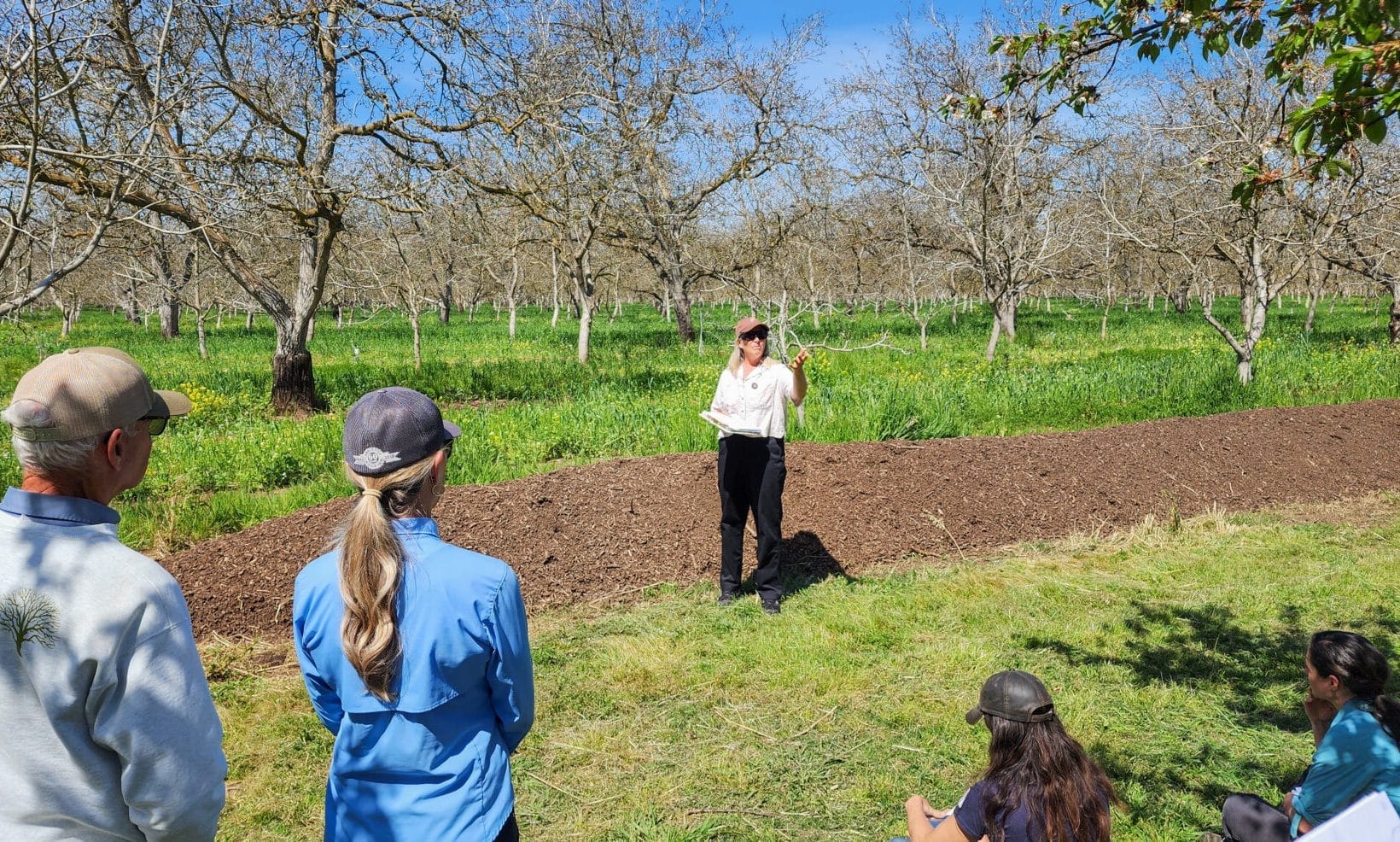
Marney also emphasized the potential opportunities for farmers to create additional revenue streams through the sale of their compost. Heartwood’s nutrient-rich compost serves as an example of a value-added product. Emma commented, “We got the results of the nutritional composition of [the compost] and notably, our lab [advisor] said that if you screened out the extra carbon wood material, this would be fine to sell as a gardener’s compost. He said it was garden grade and highly desirable.”
Marney offered resources for growers who may be interested in starting their own composting journey. She provided contact information for several labs that offer soil testing and advising services, including Control Labs, Cornell University Soil Health Lab, and Woods End Laboratories. She highlighted why she thinks it is important for farmers to utilize the available technical lab assistance to help them create compost.
“What makes composting unique is that humans are involved in it. And we apply our knowledge and our will…so you have the capacity to actually create something even better than what nature has created in her decomposition process. And that’s why you would work with a soil lab that specifically works with composting, because the science is there. [And] we’ve made amazing advances in the composting industry.” – Marney Blair
Ultimately, the field day provided attendees the opportunity to reflect on their own capacity to drive biologically-integrated agricultural practices such as cover crops or composting on their farm, underscoring the collaborative nature of securing the necessary resources for their successful implementation.
If you would like to listen to Franz, Emma, and Marney talk more in depth about their project, check out their talk at our 2024 Small Farm Conference here, and check out more recorded talks from the Small Farm Conference on the CAFFflix Youtube channel.
You can also check out the reporting on this event by West Coast Nut Magazine here.