
BIOS in Walnuts
What is BIOS?
Biologically Integrated Orchard Systems, or BIOS, is a whole-systems approach to farming that brings together growers, scientists, farm advisors, and pest control advisors with the goal of implementing farm practices to reduce dependence on chemical inputs. This approach utilizes comprehensive pest management practices that enhance natural pest control, reduce harmful insecticide sprays, and prioritize biological methods that are selective, low-risk, and effective.

History
The BIOS program was originally started in 1993 in partnership with CAFF, almond growers in Merced County, and the University of California Sustainable Agriculture and Research Program (UC SAREP). This collaboration paired on-farm demonstrations of biological practices with farmer-to-farmer information-sharing of their results. Following its success, this effort was expanded with the UC Cooperative Extension to walnuts in Yolo, Solano, San Joaquin, and Stanislaus counties. The BIOS model has since expanded to include other cropping systems and is now known as Biologically Integrated Farming Systems, or BIFS.
CAFF's BIOS Project
The BIOS program was originally started in 1993 in partnership with CAFF, almond growers in Merced County, and the University of California Sustainable Agriculture and Research Program (UC SAREP). This collaboration paired on-farm demonstrations of biological practices with farmer-to-farmer information-sharing of their results. Following its success, this effort was expanded with the UC Cooperative Extension to walnuts in Yolo, Solano, San Joaquin, and Stanislaus counties. The BIOS model has since expanded to include other cropping systems and is now known as Biologically Integrated Farming Systems, or BIFS.
Practices
Mating Disruption
Target Pests
Codling moth (CM) and Navel orangeworm (NOW) are two significant pests of walnuts. These moths, in their larval or “worm” stage, will bore into the developing walnut and feed directly on the kernel. CM can infest nuts throughout the season, but NOW will only infest nuts after hull-split which happens a couple weeks before harvest. However, early-season CM damage can allow NOW to attack nuts before hull-split. While CM only lays one egg per nut, NOW can lay multiple eggs per nut, which makes it crucial to properly control both pests.
How it works
The adult female moth releases a pheromone to attract male moths to her so that they can mate. Mating disruption (MD) utilizes synthetic pheromones that mimic the female pheromones to saturate the orchard and confuse the male moths, preventing the males from finding females to mate with. This reduces the number of eggs laid, thereby reducing pest populations in the long-term.
Why use mating disruption?
Unlike broad-spectrum pesticides, mating disruption is specific to the target pest and low-risk. Especially for pests like codling moth and navel orangeworm, the commonly used pesticides can kill off beneficial insects and cause secondary flare-ups of other pests like spider mites and aphids. The synthetic pheromone used in mating disruption can be applied in sprayable liquid form, aerosol dispensers, or plastic strip dispensers. Mating disruption works best when used in concert with intensive monitoring, in-season nut sampling, and harvest damage assessments.
Predatory mite releases and cover crops
Target Pests
Webspinning spider mites (WSM) are minute arachnids, closely related to ticks and spiders. They do not feed directly on the walnut fruit, but instead feed on the leaves. This can cause the leaves to turn brown and fall off the tree, and severe damage can reduce nut yield and quality. Spider mites reproduce rapidly when it is hot, dry, and dusty. In favorable conditions, they can complete a generation in just 7 days. Because of that, there is a high risk of spider mites developing resistance to the miticides that are frequently used to control them.
How it works
Biological control, or biocontrol, is a method of pest management that utilizes naturally-occurring beneficial organisms, such as predators. Mites of the Phytoseiidae family, or commonly known as predatory mites (PM), are a key predator of webspinning spider mites. Maintaining an adequate ratio of predatory mites to spider mites can help keep spider mite numbers low enough without having to spray a miticide. Releasing predatory mites can supplement the already existing predator population to keep a favorable predator-to-prey ratio. These releases can be done by hand, leaf blower, or drone.
Cover crops: how it works
Cover cropping is not only a cornerstone practice when it comes to improving soil health, but is also foundational to the biological control of pests. They can be used to boost the existing population of natural enemies to maintain the favorable predator-prey ratio. Spider mite predators include predatory mites, spider mite destroyers, minute pirate bugs, big-eyed bugs, and more. Cover crops provide the food and habitat necessary for these natural enemies to thrive. This is especially important early in the season, when the numbers of spider mites are still relatively low and insufficient to maintain large predator populations. A beneficial insect attracting mix might include brassicas, legumes, grasses, and flowering broadleafs.
Learn more about EPM

Whole-Orchard Nutrient Management & On-Farm Composting at Heartwood Farms
On April 10th, Community Alliance with Family Farmers (CAFF) hosted a field day at Heartwood Farms in Linden, CA with farmers Franz Eilers and Emma
Exploring Direct to Consumer Markets at Tenderly Rooted Farm Field Day
On October 5th, attendees gathered at Riverwood Farm in Biggs, California to listen to Kaben Kramer of Tenderly Rooted tell his story of creating a

BIOS Field Day at Locke Ranch
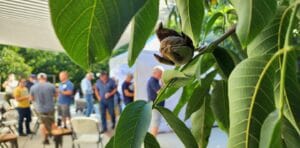
The Community Alliance with Family Farms (CAFF) held a Biologically Integrated Orchard System (BIOS) field day at Locke Ranch on May 23rd. Attendees were treated
Our Team in the Field
In collaboration with eight farms over two years, we set up trials of these alternative practices, and collected data throughout the season to determine how well they worked.
Implementation Stats
8 Farms
Total acres
670 Acres
Applied mating disruption on
360 Acres
Released predatory mites on
275 Acres
Planted cover crops on
270 Acres
Partner Farms
Blossom Farms, Bullseye Farms, Ferrari Farms, Fillmore Farms, Mid-Cal Macedo Ranch, River Garden Farms, Sierra Orchards
Listen to learn more about the history and legacy of BIOS
The Legacy of Biologically Integrated Orchard Systems (BIOS) in Walnuts: Part 1
The Legacy of Biologically Integrated Orchard Systems (BIOS) in Walnuts: Part 2
Mating Disruption for Codling Moth and Navel Orangeworm
Cover Crops for Spider Mite Management
Predatory Mite Release
Predatory mite release via leaf blower
Predatory mite release via drone (Video by Ryan Fillmore)