
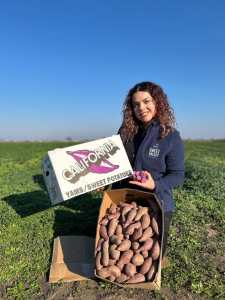
 In the heart of the Central Valley, Angelica Estrada is carving out space for something different. Something rooted in legacy, resilience, and reinvention. As the founder of Sweet Valley Produce in Merced, Angelica is growing more than just sweet potatoes. She’s nurturing a community-focused vision that uplifts local farmers, reduces food waste, and makes fresh, local produce more accessible.
Rooted in Family and Experience
Angelica’s journey into farming was shaped by her family’s long history in the produce industry. Her parents began distributing produce in the 1980s, building a business with determination and grit but without much formal training. When the tech industry began changing the landscape, they struggled to keep up. Angelica saw an opportunity to return with tools they didn’t have.
She studied economics to bring structured education back into the family business. Along the way, she gained experience in food safety, worked in fresh-cut processing, and did business advising with KTA. Each role helped her move closer to her goal of supporting her family’s business and the farming community around her.
When it came time to grow something of her own, sweet potatoes felt like the natural choice. They are widely grown in the region, and as Angelica explained, they became a great way to help other farmers transition into regenerative and organic practices. Sweet Valley Produce now sells to mom-and-pop shops, restaurants, and local distributors.
Sweet Roots Kitchen
Angelica recently launched Sweet Roots Kitchen, a retail and wholesale space designed to connect local farms with the community. A self-described foodie, she took inspiration from farm-to-table restaurants in bigger cities and asked herself, why not Merced?
Sweet Roots Kitchen offers a build-your-own salad concept using locally grown produce. It combines the accessibility of fast-casual dining with a strong focus on sourcing from nearby farms. Although it’s not in a high-traffic location and isn’t a sit-down restaurant, Angelica sees value in its urban feel and potential to grow.
Beyond the retail model, Angelica is developing a fresh-cut processing arm of the business, supplying institutions and restaurants with ready-to-use produce. With support from a grant and upcoming commercial equipment, she plans to reduce food waste by putting scratched or imperfect sweet potatoes to good use. This will also give farmers an added income stream for produce that might otherwise be tossed.
Breaking Barriers
As a woman of color in agriculture, Angelica has faced more than a few challenges. She shared how sexism often becomes more visible when working in male-dominated environments. There have been times when men have questioned her authority, asked if her husband or father could handle business instead, or used flirtation as a form of leverage in professional settings.
“You have to manage those relationships,” she said. “People underestimate women. If you don’t have the right support, it can be really difficult.”
Still, Angelica remains committed. She is proud of the relationships she’s built and the farmers she’s helped. One moment that stands out to her is helping a farmer who had been struggling since the LA riots. She was able to buy produce that his family couldn’t sell, giving him another chance to stay in the business.
Advice for New Farmers
Angelica doesn’t sugarcoat what it takes to get started in farming. “The beginning is really hard,” she said. “It’s expensive, and you’ll probably have to keep working a 40-hour job while you build.”
Her most important advice is to build a strong support network. “Farming is community-based. You can do it alone, but it’s so much better when you have others around you,” she said. She encourages new farmers to believe in their skills and not let barriers hold them back.
Looking Ahead
Angelica’s work is rooted in impact. Whether it’s creating market access, offering value-added product space, or simply giving local farmers another outlet to sell what they grow, she is building a stronger, more connected food system in Merced.
“We want to make the space more available to farmers,” she said. “Whether it’s making salsas, creating value-added products, or needing a place to move extra produce, this is for them too.”
Learn more about Sweet Valley Produce and Sweet Roots Kitchen at svproduceinc.com.