
On the 27th of March, the Community Alliance With Family Farmers (CAFF) held a field day with Machado Family Farms in Linden, CA. This event focused on sharing the story that led to the success of integrating sheep for grazing cover crop in walnut orchards and a mix of interactive farming activities where attendees could learn more in depth about topics like pest management and soil health.
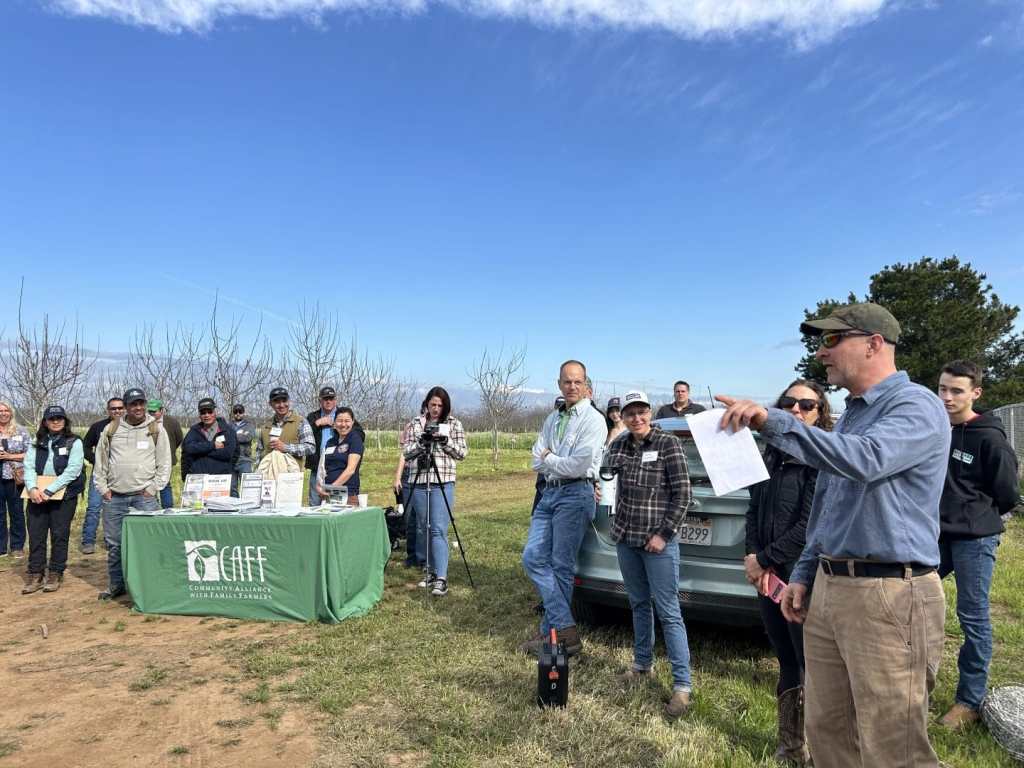
The event began with Drew Cheney of Machado Family Farms introducing himself, his wife Melissa Machado Cheney, and their lovely children. Originally from Colusa, he comes from a farming background as his father was a rice farmer. A fourth-generation farm, Machado Family Farms started about 80 years ago with sheep, row crops, and orchards. Today they grow walnuts, almonds, cherries and olives. For the field day, attendees observed six treatments of cover crop seed mixes in both a young and mature block of walnuts. Included in these treatments was a custom grazing mix developed for the farm to increase forage availability.
When Drew began managing the farm he asked “How do you improve soil health and tree resiliency without a lot of external inputs?”. They have been practicing cover cropping for about 7 years now but sheep grazing was always a goal in the back of their minds. Sheep were finally introduced 4 years ago when sheep rancher Vince Arburua suggested it to Drew after coming across his farm during product deliveries. Vince saw all of the cover crop at work in Drew’s orchards and suggested he get some of his sheep to graze it, and of course Drew was very on board with the idea. This provided Vince and his brother Frankie an opportunity to provide their flocks with superior feed, and they now bring all of their animals to the farm before the end of the grazing season. They started off with 800 sheep, then 1100, which grew to 1500. This year they are looking to have 3,000.
“I introduced faster nutrient cycling in the orchard by utilizing sheep, and reduce fertilizer input drastically and at the same time increase resiliency in the trees” – Drew Cheney
Drew mentioned how their PCA was skeptical about sheep roaming, but due to grazing they were able to reduce sprays significantly–eliminating early-season pesticide applications, and reducing late-season applications by two or three–and that’s how the benefits outweigh the costs. However the success of the sheep grazing can also be attributed to the selection and the variety of the cover crop mixes planted.
“Standard” mixes that focused just on pollinators or soil building didn’t perform as well with sheep, so changes were needed. Cover crop expert Tom Johnson was able to develop a mix with Drew that provides a long season of grazing potential. Tom explained that over the years the recommended amount of plant species in a mix has gone from 2 to 20, but it’s best to increase cover crop diversity after practicing cover crops for several years and building up soil biology. Keeping in mind what plants thrive can and should evolve over the years, with varying results. Besides increasing soil health, one of the goals of planting cover crop that Drew had was to increase the roots in the ground to improve water infiltration in the orchards.
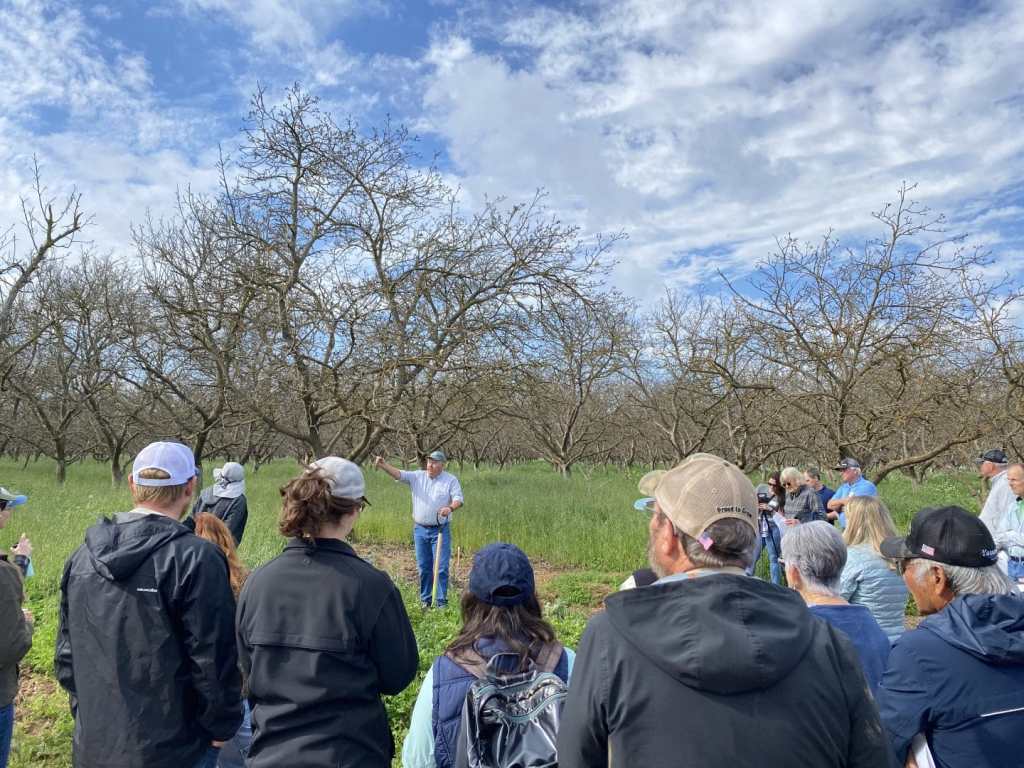
Attendees moved towards the mature orchard and got to hear more about cover crops, soil health and pest management in-depth through different activities. Tom began the cover crop segment by taking attendees though the different sample cover crop mixes that were planted throughout the mature orchard, starting out with Grower’s Mix D and ending with the Forage mix. He pointed out that not everything has shown up and some might show up later and how important it is to know the characteristic of each plant. One of the downfalls of walnuts is putting in something that is strong enough to come up through the leaf litter, since the chemistry in the litter, no light hitting the ground and getting the seed in the ground all become challenges. Triticale was one of the optimal plants to use in the orchards due to its root systems, adaptability of characteristics, and winter and spring varieties for longer grazing periods.
“Sheep like to make a salad, eat bites of each plant at a time”- Drew Cheney
They also added a different variety of faba beans into the Forage mix as they say that sheep showed to really like those, choosing and incorporating different plant varieties is ideal for working with cover crops. Drew also mentioned that he would rather have a variety of plants growing as it indicates that the soil is healthy.
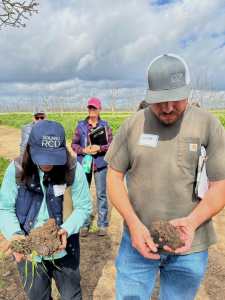
Then attendees proceeded to split up into two groups, one focusing on soil health and the other on pest management activities. Sara Tiffany with CAFF began by informing attendees of soil types, infiltration and the importance of the organisms in the soil. Using a soil probe, she gathered a sample of the mature orchard’s soil and passed it around for attendees to feel its texture and see its color, which were both indicators of its health. Drew added that the application of organic compost down the middle of the tree rows and not spraying herbicide has significantly helped their soil’s ability to thrive.

And in the pest management activity CAFF’s Moet Takata and Hanna Kahl walked attendees through a demonstration of using a sweep net to collect insects from the cover crops in the orchard as well as sticky cards. “The most effective way of sampling for insects is using different methods” – Hanna Kahl. As they discussed how cover crops help minimize dust which leads to mite issues, attendees added that they have used crushed walnut shells for dust control as well. As for sticky cards, Moet mentioned that they didn’t see as many insects on the sticky card that was set up in the plain grass of the orchard vs. the cover cropped section, indicating that the cover crops provide more habitat for beneficial insects. Additionally, something that Drew noticed when mowing with the tractor was lots of predatory (beneficial) insects on the front of the tractor and how a lot more of them will disperse to the trees as sheep graze since the sheep move slower, compared to working with the tractor.
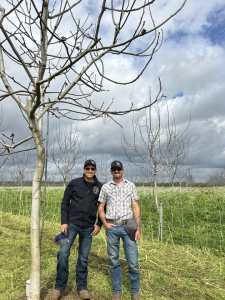
To wrap up the day, attendees shifted over to the younger orchard where they got to see the freshly grazed cover crop and hear more from Vince and Frankie’s grazing perspective as 4th generation sheep ranchers. The world of permanent crop grazing was new to them before working with Drew, but it has proved to be a great success for them. Their goal along with Drew’s is to have the sheep in the orchards as close to the 120-day Pre-Harvest Interval as possible, until about the start of June. The sheep provide biomass cycling and natural fertilizer though urine which minimizes any external inputs and cuts costs. However, due to food safety concerns, Drew has been talking to UC Davis for the past two years with the goal of getting more science and quantitative numbers behind shortening the PHI, so that handlers can make mitigation plans for food safety issues. The sheep spread out and graze evenly, limiting compaction which was a concern for some attendees. They also adapt to the heat by using the shade the herder provides and drinking water, noting that they see the sheep switch out and take turns. Vince notes that they can see the sheep are healthy and kept happy with the varied cover crop mix that was designed specifically for them to graze.
“The diversification of what’s happening in the field, leads to healthier soils which lead to healthier foods”- Drew Cheney
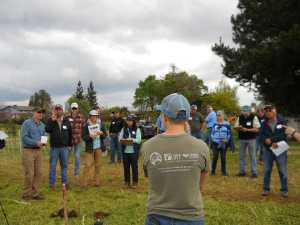
Ultimately, the field day was a great opportunity for farmers to be inspired by what Machado Family Farms has accomplished through introducing and combining the ecological practices of cover cropping and sheep grazing in walnut orchards all while keeping beneficial insects undisturbed and reducing external inputs & costs. Attendees got to see the system at work firsthand through the freshly grazed vs. ungrazed cover crop, sheep at work, comparison of the orchard soils, and demonstrations on evaluating beneficial insect presence. The field day provided a space for rich conversation to take place on all things cover crop and grazing. Taking the leap towards adapting these practices can be intimidating but it’s all about talking to and collaborating with others, in this case Vince Arburua and Tom Johnson.
“In the end the aspect of all things working together is the most important part”- Drew Cheney

If you are interested in keeping up with all the wonderful things that are happening on this family farm you can follow them on Facebook or Instagram.
And check out CAFF’s awesome video recapping the field day here!