Organic
Certification
We help growers achieve organic certification through one-on-one technical assistance, field days, resources and more.
Supporting farmers as they transition to organic.
Through the United States Department of Agriculture’s (USDA) Transition to Organic Partnership Program (TOPP), CAFF supports transitioning farmers with organic certification in California. We assist farmers with their unique organic certification needs through comprehensive technical assistance, events, resources, and more.
ORGANIC CERTIFICATION SERVICES

TECHNICAL ASSISTANCE
We provide one-on-one support to farmers pursuing or renewing organic certification, including but not limited to: answering questions about organic certification, communicating with certifiers and helping comply with certifier requirements.

ORGANIC SYSTEM PLANS
Each certifier has their own Organic System Plan templates. Be sure to reference your certifier’s unique OSP requirements when you are preparing for certification. Click the button below to see a generalized USDA Organic System Plan template so you can know what to expect.

MENTORSHIP
The USDA Transition to Organic Partnership Program (TOPP) connects producers transitioning with experienced organic producers who serve as mentors. These mentors guide them through the transition process and offer valuable insights into their journey into organic farming.
ORGANIC CERTIFICATION RESOURCE TOOLBOX
This resource collection includes valuable information from a variety of external organizations, partners, and CAFF’s internal guides and templates to help you succeed on your organic farming journey.
ORGANIC CERTIFIER COMPARISON TOOL
CAFF's Organic Certifier Searchable Comparison Tool is meant to support growers in selecting a "right-size" organic certifier that meets a farm's specific certification needs.
EVENTS
We offer field days across California to help farmers connect and share ideas about organic farming practices. Check our Events Page for upcoming field days near you.
FREQUENTLY ASKED QUESTIONS
What is an Organic System Plan?
- To apply for organic certification, a farmer must create an organic system plan, which is a detailed document outlining how your production, processing, and/or handling practices meet the requirements of the National Organic Program standards. Organic system plans must include:
- a Materials List containing all substances used, including fertilizers, pesticides, soil amendments, and healthcare products and feed for livestock
- a Farm Map showing all production areas and illustrating how organic production areas are kept separate from non-organic production areas and neighboring properties
- a complete field history for all organic production areas verifying that those areas have been free of prohibited substances for 36 months
- A Biodiversity Plan outlining how your organic production practices maintain or improve natural resources on and surrounding the organic production areas
How do I choose a certifier?
There are many different USDA-accredited organic certifiers. When choosing a certifier, a farm may want to consider their scope of certification (crop, livestock, wild-harvested crops, processing/handling), whether the certifier charges based on acreage or gross revenue, and the additional certifications or services that the certifier may offer for its clients. For a detailed resource comparing the offerings of different organic certifiers, see CAFF’s Organic Certifier Searchable Comparison Tool (link above).
What are the requirements for going organic?
Certified organic farms must design their production systems to comply with the National Organic Program standards, which emphasize specific practices like crop rotation, cover cropping, soil nutrient management through compost or animal manures, and biological pest control. Many synthetic fertilizers, insecticides, and fungicides are prohibited in organic production. A farm seeking organic certification must have been free of prohibited substances for 36 months before the first certified-organic harvest. Certified organic farms must keep detailed records outlining their production practices, and will be inspected annually to ensure compliance with organic standards.
What can I expect from an organic inspection?
An accredited organic inspector will visit your farm once annually to ensure that the organic practices outlined in your OSP accurately reflect what you are doing on-the-ground at your farm. The organic inspector can assist you in updating your OSP as needed, including changes to your Materials List and incorporating additional organic parcels if applicable. The inspector will look at your field conditions, water source/irrigation systems, chemical storage area, wash/pack infrastructure, and will do a detailed audit of your OSP paperwork, including purchase receipts, planting and harvest logs, and sales records.
How can I get financial assistance?
- Transitioning land to organic and becoming certified can be expensive. There are a variety of cost-share programs and grants available to help offset the cost of transition and certification for organic producers:
- USDA Organic Certification Cost Share Program: https://www.fsa.usda.gov/programs-and-services/occsp/index
- NRCS National Organic Initiative: https://www.nrcs.usda.gov/programs-initiatives/eqip-organic-initiative
- CCOF Organic Transition grants: https://www.ccof.org/foundation/grants-education/organic-transition/
RESOURCES

2025 NOP/FSMA/3rd Party Audit Food Safety Guide (Updated)
This updated guide for 2025 provides charts that give a side-by-side comparison of the similarities and differences between the requirements of the National Organic Program, Food Safety Modernization Act, and

Organic Small Farmer Marketing Toolkit
Para español: Kit de herramientas de marketing orgánico para agricultores de pequeña escala Looking to grow your organic business and connect with more customers? The Organic Producer Marketing Toolkit from
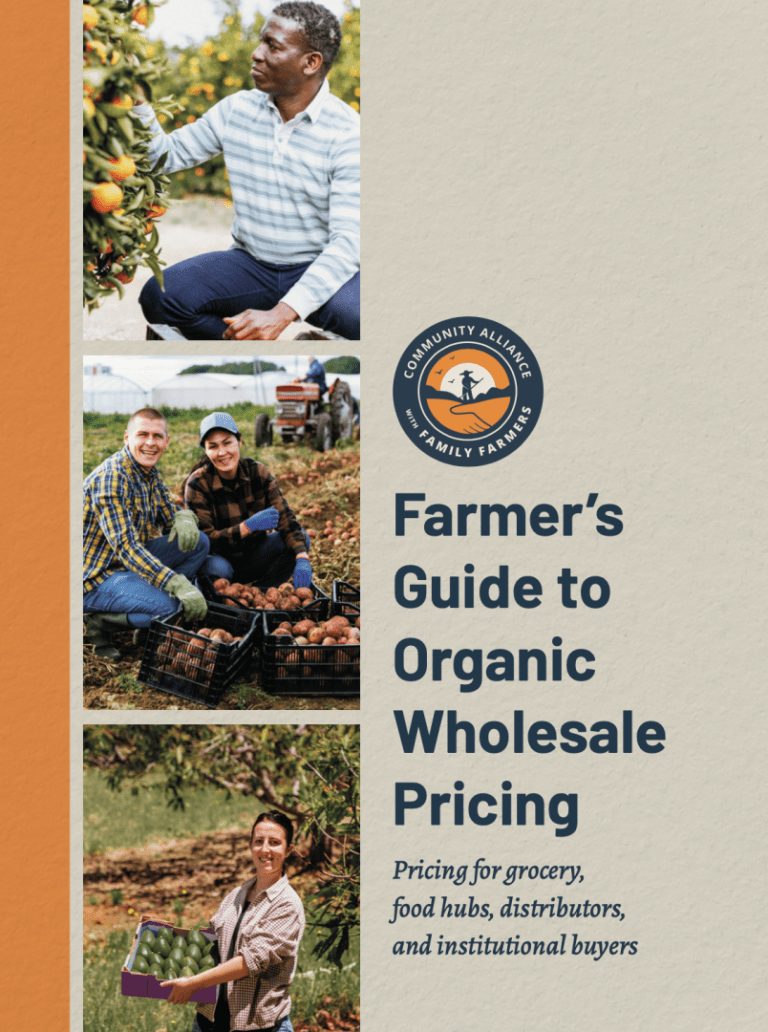
Farmer’s Guide to Organic Wholesale Pricing
The Farmer’s Guide to Organic Wholesale Pricing was created in response to the question, “How much will I be able to charge for my organic crops in wholesale markets?” There

NOP/FSMA/3rd Party Audit Food Safety Guide
This guide provides charts that give a side-by-side comparison of the similarities and differences between the requirements of the National Organic Program, Food Safety Modernization Act, and 3rd Party Food
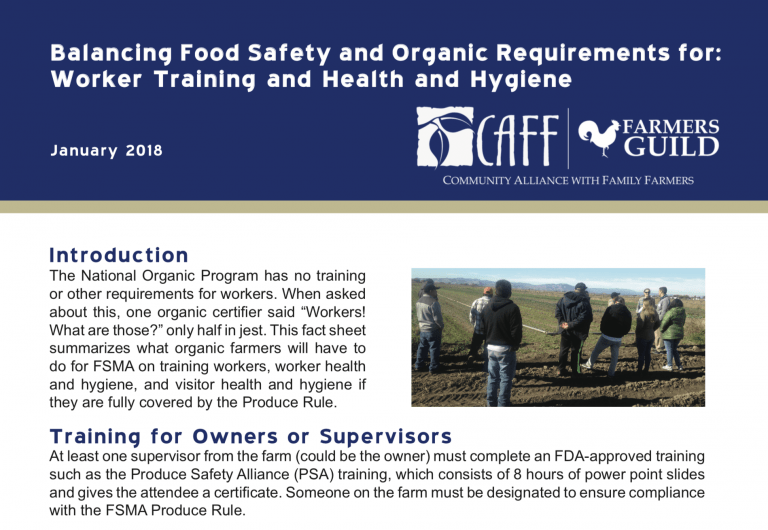
Worker Health & Hygiene: FSMA & NOP
This factsheet explains what farms that need to be in full compliance with the federal Food Safety Modernization Act (FSMA) worker health and hygiene requirements. There is also an overview
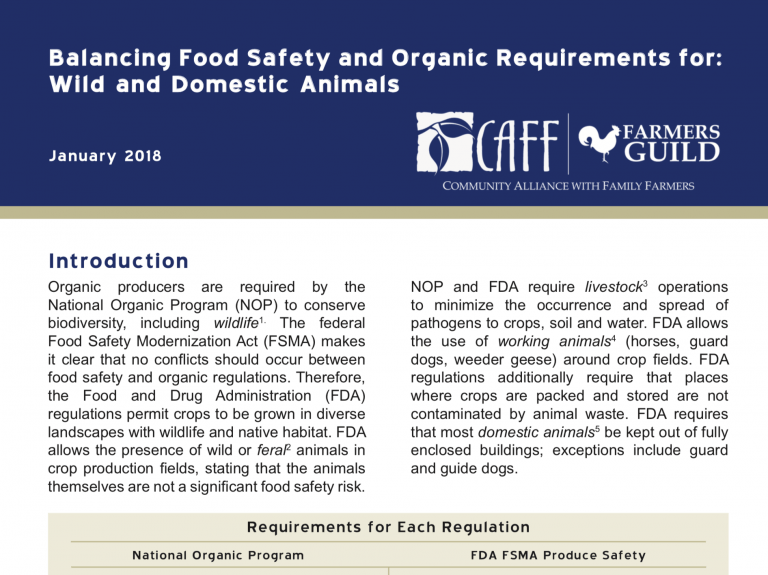
Wild & Domestic Animals: FSMA & NOP
This factsheet provides an overview of what farms that need to be in full compliance with the federal Food Safety Modernization Act (FSMA) need to do to meet wild and
GOT ORGANIC CERTIFICATION QUESTIONS?
Submit the form below or email us at farmerservices@caff.org.