
Elbow Operated Hand Wash Station
2022-23 Innovation Challenge Winner
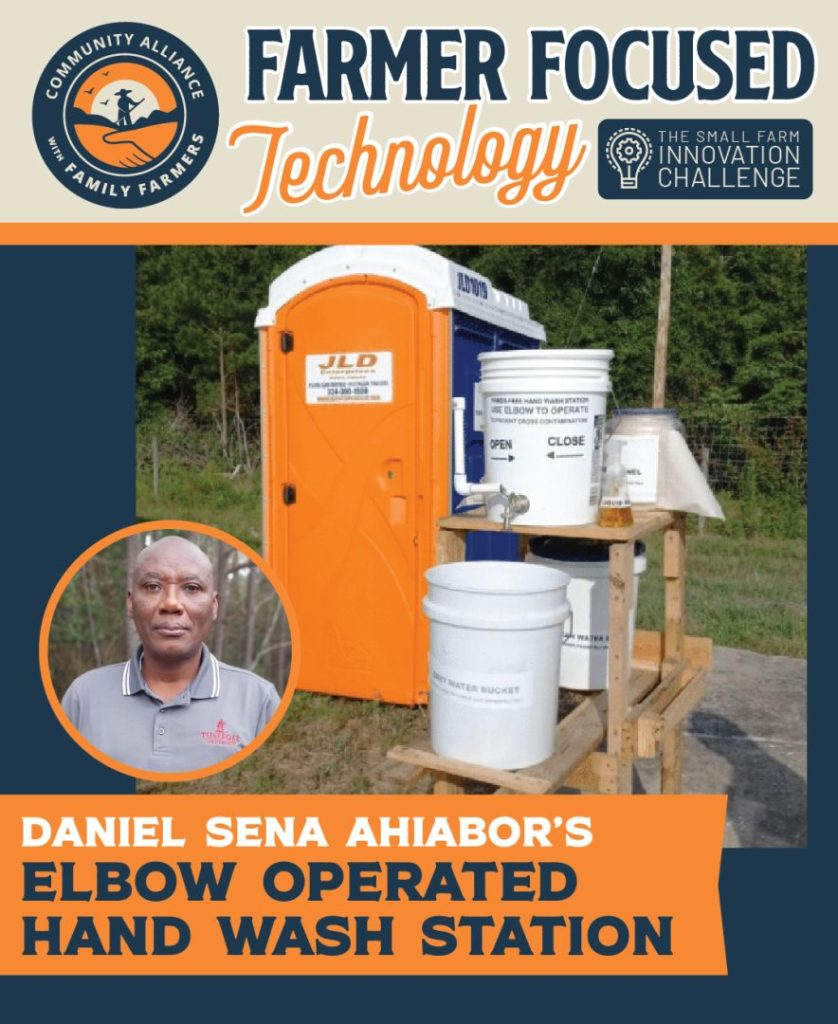
The Elbow Operated Hand Wash Station offers an affordable in-field solution with a fresh twist to the design, especially for lower-resource farmers. Using only a few materials easily found at a hardware store, this innovation makes it easier to meet the requirements of Good Agricultural Practices (GAP) and improve on-farm sanitation for workers.
Problem solved: Hand washing station useful for field settings where mobility, water conservation, and hygiene are priorities.
Skills/tools needed: Basic carpentry and plumbing skills are enough to complete the build. 5-gallon lidded water bucket, PVC pipe and fittings (1⁄2 inch, L-shaped, elbow-operated), wood for the frame and shelves, a liquid soap dispenser, hand sanitizer, a paper towel container, and extra buckets for greywater and backup supplies.
Cost: $150-$200
Best suited for: field settings where mobility, water conservation, and hygiene are priorities.
INNOVATOR PROFILE
Sena’s enthusiasm for innovation and creative solutions has led him to become a two time winner of the Do It Yourself category of the Challenge. Sena grew up in a farming family in Ghana and graduated from Tuskegee University, Alabama with an M.Sc of Plant and Soil Science. He now works as an agronomist and a Post-Harvest Specialist working for Tuskegee University Cooperative Extension Program. Sena has won the Trellis Grant twice from the Horticulture Innovation Lab at the University of California at Davis. He is a constant innovator and fixer; from repairing the local solar dryer to helping build zero energy cooling chambers for farmers in Ghana. His continued commitment to small farmers highlights the importance of accessible, practical solutions that improve working conditions and food safety.
INNOVATION
The Mobile Hands-Free Hand Wash Station works great for hygienic hand washing by using a creative pipe placement for elbow operation. It is a simple structure that anyone can build with access to a hardware store or by using reclaimed materials. A long-handled L-shaped 1⁄2” PVC pipe which is elbow-operated allows the user to wash their hands without touching anything, preventing cross contamination. Beneath sits an empty bucket to collect the grey water. Provisions are made with buckets on the other two shelves for extra water and extra paper towel, soap and hand sanitizer. Its screws dismantle so that it can be packed down and relocated.
PROBLEM SOLVED
For the Mobile Hands-Free Hand Wash Station, its mobility, cheapness to construct, and water saving and grey water capture makes this a more accessible option compared to the conventional hand washing stations. The station can also be moved to different parts of the farm during harvest for easier access.
HOW TO BUILD IT & WHAT ARE THE COSTS?
Approximate material cost is $155 when items are purchased in bulk or shared across multiple builds. The cost is around $200 if everything is bought individually at retail. This includes a 5-gallon lidded water bucket, PVC pipe and fittings (1⁄2 inch, L-shaped, elbow-operated), wood for the frame and shelves, a liquid soap dispenser, hand sanitizer, a paper towel container, and extra buckets for greywater and backup supplies. Basic carpentry and plumbing skills are enough to complete the build. A power drill, saw, and simple hand tools are sufficient. Fixtures like PVC fittings and buckets can be reused or shared between builds to keep costs down.
The station is simple, quick to replicate, and easy to train others on. A step-by-step manual can be developed to support wider adoption. This design is especially useful for field settings where mobility, water conservation, and hygiene are priorities.
Watch Sena Daniel Ahiabor operate his Elbow Operated Hand Wash Station:

About this resource:
CAFF’s Small Farm Tech Hub produced a booklet highlighting selected winners from the annual Small Farm Innovation Challenge.
Innovations were submitted by farmers in the category of “Do It Yourself” or DIY. This booklet only highlights a handful of total applicants to the Challenge. These innovations exemplify how simple DIY innovations can lead to significant improvements in the farm and offer blueprints that can be adapted, improved upon, and implemented by other farmers.
As applicants of the Innovation Challenge, their contribution to agricultural technology showcases the power of practical, scalable solutions in transforming the small farm landscape. The Innovation Challenge invites farmers, entrepreneurs, students, hackers and any ingenious, farm-loving thinkers to propose tech-based innovations that will help small scale agriculture compete, survive and thrive. All ideas, big or small, in any phase of development, will be accepted for the Innovation Challenge. Learn more by visiting www.caff.org/innovation.
A printable booklet can be viewed here.
Check out our other highlighted innovators:

