
Three weeks ago, I found myself being discharged from the emergency room in Bishop, California instead of heading out to the trailhead to start our backpacking trip. The doctor was fairly certain I didn’t have the parasite cyclospora, but a different GI virus, potentially norovirus. We couldn’t know for sure, since the hospital lacked on-site testing.
If you’ve had cyclospora or another GI illness recently, you’re not alone, and I sympathize. So how do we reduce these cases?
It starts on the farm.

Why Small Farms Matter for Food Safety
Even in our complex food system, most of what we eat starts on a farm somewhere. Smaller, local farmers are critical to keeping our food safe: they shorten the distance between where food is grown and where it ends up on our plates. Fewer steps and less handling in the chain means less risk of contamination, and local farmers are deeply invested in the relationships and reputations that come with selling close to home.
Every farmer in California, regardless of size, has to follow good agricultural practices: proper hygiene, careful attention to irrigation and postharvest water quality, never harvesting crops contaminated with feces, and dozens of other common-sense measures. With support from organizations like Community Alliance with Family Farmers (CAFF), small farmers meet critical state and federal food safety regulations like irrigating in risk-reducing ways (such as drip irrigation instead of overhead), washing produce postharvest only with municipal or tested well water, and keeping employee hygiene practices strong. CAFF also provides farmers with free microbial water testing through a program you can learn more about here.
As a consumer, you can reduce your own risk by buying from local farmers when possible, and by choosing whole, unprocessed produce, like a head of lettuce you wash and prep yourself as opposed to pre-cut, bagged salad.
Two Decades of Work — and Real Results
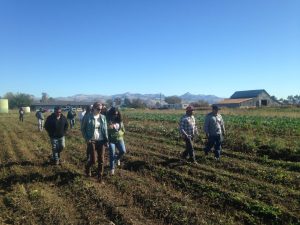 At CAFF, we’ve spent the last 20 years finding resourceful ways to support small farmers with food safety training and technical assistance. We started our Food Safety Program in 2006, in the wake of the Central Coast spinach outbreak. In just the last decade, we’ve:
- Conducted over 145 food safety trainings for more than 3,500 farmers
- Produced 19 podcast episodes on food safety
- Provided free food safety plan templates in English and Spanish
- Helped more than 260 farmers complete full farm food safety plans
The Need Still Outpaces the Resources
And yet, the need across California is immense, especially among small and beginning farmers. According to the 2022 Census of Agriculture, California has 63,134 farms, and 21,751 of them are new and beginning operations.
Right now, we have just a handful of staff members who squeeze food safety work into their broader job duties. Together, they add up to barely more than half of one full-time position dedicated to this work across the entire state. Realistically, we’d need closer to four full-time staff to meet the need. And that’s in addition to needed funding at the Centers for Diseases Control and local public health departments to address outbreaks.
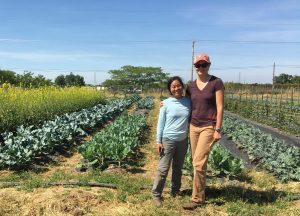 Through years of farmer feedback, we’ve learned that one-time workshops help, but they aren’t enough on their own. That’s why we launched the Food Safety Partner Farm Program in 2019: farmers in the program make lasting improvements, build new habits, and pass that knowledge on to neighboring farms through field days. It’s quality over quantity. And it works. It also takes far more staff time to run.
For 20 years, our only funding for this work has come from state and federal grants. With the current political climate, that lifeline is less secure than ever. Food safety is foundational to successful farm operations and to getting California-grown food onto everyone’s plates, including schools, hospitals, universities and beyond.
Right now, the public’s attention is on food safety for all the wrong reasons. But when this work is properly funded, farmers can partner with CAFF, University of California Agriculture & Natural Resources, and other nonprofits to quietly keep our food supply safer—often without anyone noticing at all.
Kali Feiereisel, MPH, Farmer Services Director, Community Alliance with Family Farmers