By: Jade Gutierrez, CAFF Ecological Farming GrizzlyCorps Fellow
On the 24th of April, the Community Alliance with Family Farmers (CAFF) gathered in Clarksburg, CA for a field day hosted at Reamer Farms. This event focused on integrated pest management (IPM) approaches of increasing natural enemies of spider mites in vineyards. It provided first-hand demonstrations of beneficial insect release via drone and food spray’s ability to encourage the activity of beneficial insects.
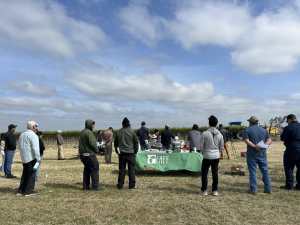
Attendees gathered at the field day, hearing from Chris Storm.
The event began with Hanna Kahl, Ecological Pest Management Senior Manager at CAFF, giving some context to attendees about the BIFS research trial that CAFF and Reamer Farms had collaborated on in 2023 and 2024. The purpose of this effort was to try to manage pests like spider mites utilizing three different treatments and a control which included natural enemy releases of predatory mites, predator food sprays, and methyl salicylate. The goal of this field trial was to encourage the adoption of these practices through reliable information and data in order to support implementation.
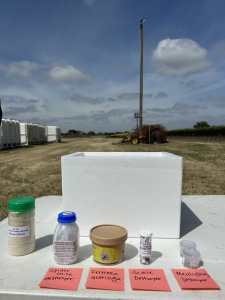
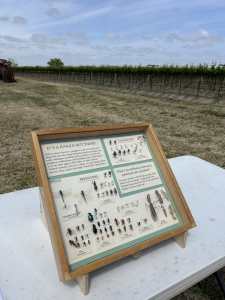
Samples of beneficial insects for release.A display drawer from the Bohart Museum of Entomology consisting of beneficial predatory insects.
Following that, MaryAnn Reamer who was representing her family’s farm at the event then introduced herself as being the 4th generation on the farm, with them having a total of 1,200 acres in Clarksburg and south of the area. Along with her, Chris Storm and Charlie Starr who are independent Pest Control Advisors (PCAs) and owners of Starr and Storm Crop Solutions introduced themselves and explained that they began working with the Reamers around 3 years ago. “We work as a team with Jamie and MaryAnn to make decisions on the individual blocks across the farm” – Chris Storm. The BIFS research trial allowed the Reamers successful reduction of pesticide use on their vineyard. They have been excited about the opportunity to inoculate the field with predatory mites since the predators can build over time for when the spider mite pressure starts in the Delta. “We can approach the problems with creativity” – Chris Storm.
Rather than relying on pesticides, the Reamers have focused on creative, sustainable strategies to manage pest pressures, reducing the need for interventions like sulfur applications. Another pest that they have been managing is mealybugs, which they have kept out of the canopy particularly by using mating disruption for three years at Reamer Farms but up to a decade with other clients. “With the use of pheromone, the 1st year you see little impact, the 2nd year a little bit more, by the 3rd year it’s hard to find mealybugs from my experience”, Chris explains. They also use a beneficial insect known as the mealybug destroyer, whose larvae are effective at moving up next to mealybugs and feeding on them. While they have mostly successfully controlled mealybugs (which are the vector of leafroll diseases), they do still struggle with ridding the vineyards of leafroll disease, but they are actively brainstorming for solutions. Chris Storm wrapped up by talking to attendees about the two agriculture imaging technology programs which they’ve found to be most helpful for their operations. The first is myEV, standing for “Efficient Vineyard”, which is a mapping database platform that has allowed them to store useful data for their operations. And the second is Farm QA, a crop consulting software that allows them to create their own templates for scouting.
Jaclyn Bennett presenting to attendees all about Parabug and the drone release.
The discussion was then passed onto Jaclyn Bennett with Parabug, an agriculture technology company based in Salinas, CA that specializes in the application of beneficial insects via drones. Essentially Parabug uses a drum attached to the drone that has a series of holes all over, which allows it to act similar to a salt shaker. As the drum rotates constantly, the rotation provides uniform distribution of the material inside. This keeps the predators evenly mixed in the carrier media, which is often vermiculite or organic rice hulls. The drone flies autonomously, with its mission already planned out, and perpendicular to the rows for efficient coverage. It has the ability to fly at about an acre per minute and with reloads and battery changes, at about 45 acres per hour. They typically operate in the early morning or afternoon to take advantage of cooler temperatures and avoid wind. The timing of the beneficial insect’s arrival from insectaries determines when the releases happen, it’s most ideal for them to arrive the day before the release. And above all it is very important for Parabug to have maps of the area, air space permission, billing, delivery information, and an in-field contact beforehand which all comes from coordinating with the grower(s) being assisted.
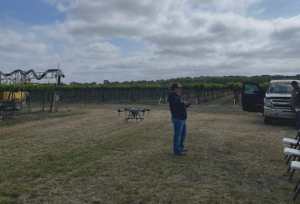
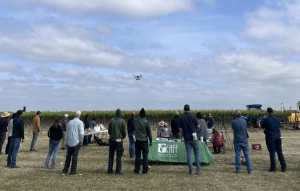
Attendees watching Parabug’s drone release demonstration.
Attendees then got to see a release of a mix of two predatory mite species that are effective spider mite predators (Neoseiulus californicus and Galendromus occidentalis), view the drone, and ask questions about the process.
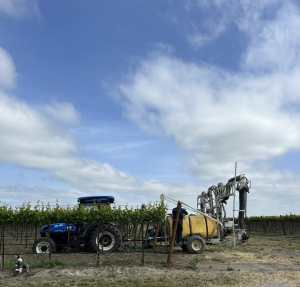
Julio Crisantos preparing for the food spray demonstration.
Julio Crisantos, who has been working with the Reamers for 20 years, did a demonstration of food spray for attendees to see how it is used to enhance populations of beneficial insects by attracting and providing them with a supplemental food source.
The field day was wrapped up by Moet Takata, Ecological Pest Management Program Manager at CAFF, who talked on the harmful effects certain miticides can have on beneficial insects. She shared a resource created that looked at data from a research paper, examining the impacts of pesticides on predatory mites from several lab trials which was turned into a usable database. The pesticides currently registered in California were pulled and each was assigned a rating based on active ingredient’s potentially harmful effects on web-spinning spider mites in walnut orchard systems. You can find the resource here.
The event highlighted practical, research-based IPM techniques to reduce pesticide use while enhancing pest control. Attendees left with actionable insights on combining biological agents, technology, and collaborative farm management to foster more sustainable vineyard practices.