
Onion Drying Rack
2023-24 Innovation Challenge Winner
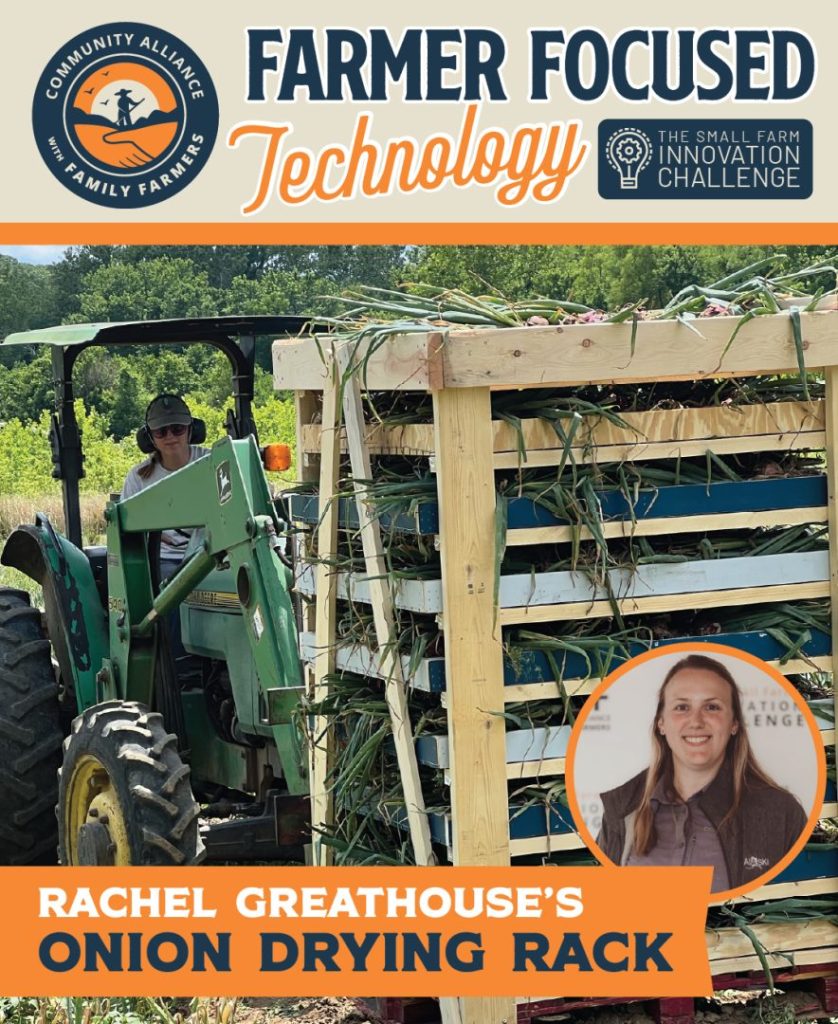
Rachel designed and built a large-scale vertical drying rack with built-in shelving, perfect for harvesting and curing onions, garlic, and more. Her design enhances the efficiency of crop drying processes.
Problem solved: crops are harvested directly onto the drying rack, saving space and time
Skills/tools needed: pallets, plywood and various sizes of lumber (2”x2”x8’; 2”x6”x8’), screws, wire mesh.
Cost: $100 – $150 per tower
Best suited for: Small to mid size farms that grow crops that require curing, like onion and garlic
INNOVATOR PROFILE
Rachel Greathouse is owner of Greathouse Garden, a small three acre farm that specializes in storage and winter crops including squash, garlic and onions. Rachel started her farm in 2022 with three acres of leased land and was able to purchase farmland in 2025.
INNOVATION
Rachel’s invention is a large-scale drying rack with removable shelves designed specifically for harvesting and drying crops like onions and garlic. The rack features wire mesh bottoms for optimal airflow and vertical drying capabilities, which not only saves space but also reduces the handling of the crops.
Key Features:
- High Capacity: Each mobile rack (or tower) holds up to 1,000 lbs of onions.
- Tractor-Ready: Built for easy transport, harvest and dry in one unit.
- Cut down from a 2-touch to a 1-touch process
PROBLEM SOLVED
Large farms have other means of curing onions, but there was a gap for the small farm on how to harvest and dry onions with fewer steps while using minimal storage space.
Traditionally, harvesting onions in small farms involves collecting them in bins and then transferring them to a drying location (typically laid out in a greenhouse with shade cloth and a single layer)—a process that typically requires handling the produce multiple times.
Rachel’s drying rack reduces this to a single step: crops are harvested directly onto the shelves of the rack, where they remain for the next two to four weeks to dry.
This innovation significantly cuts down on labor, time and risk of mishandling crops, making the post-harvest process more efficient, especially for a low value crop. Additionally, the drying rack saves space by stacking the produce rather than spreading out in a single layer.
HOW TO BUILD IT & WHAT ARE THE COSTS?
The drying rack can be easily replicable by other farmers. All the materials needed are readily available at general hardware stores; pallets, plywood, lumber (2”x2”x 8’, 2”x6”x8’), screws, wire mesh/hardware cloth. Each rack can be constructed for approximately $100-150, making this a cost-effective solution for many small-scale farmers.
Watch the build video:


About this resource:
CAFF’s Small Farm Tech Hub produced a booklet highlighting selected winners from the annual Small Farm Innovation Challenge.
Innovations were submitted by farmers in the category of “Do It Yourself” or DIY. This booklet only highlights a handful of total applicants to the Challenge. These innovations exemplify how simple DIY innovations can lead to significant improvements in the farm and offer blueprints that can be adapted, improved upon, and implemented by other farmers.
As applicants of the Innovation Challenge, their contribution to agricultural technology showcases the power of practical, scalable solutions in transforming the small farm landscape. The Innovation Challenge invites farmers, entrepreneurs, students, hackers and any ingenious, farm-loving thinkers to propose tech-based innovations that will help small scale agriculture compete, survive and thrive. All ideas, big or small, in any phase of development, will be accepted for the Innovation Challenge. Learn more by visiting www.caff.org/innovation.
A printable booklet can be viewed here.
Check out our other highlighted innovators:

